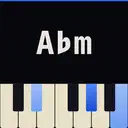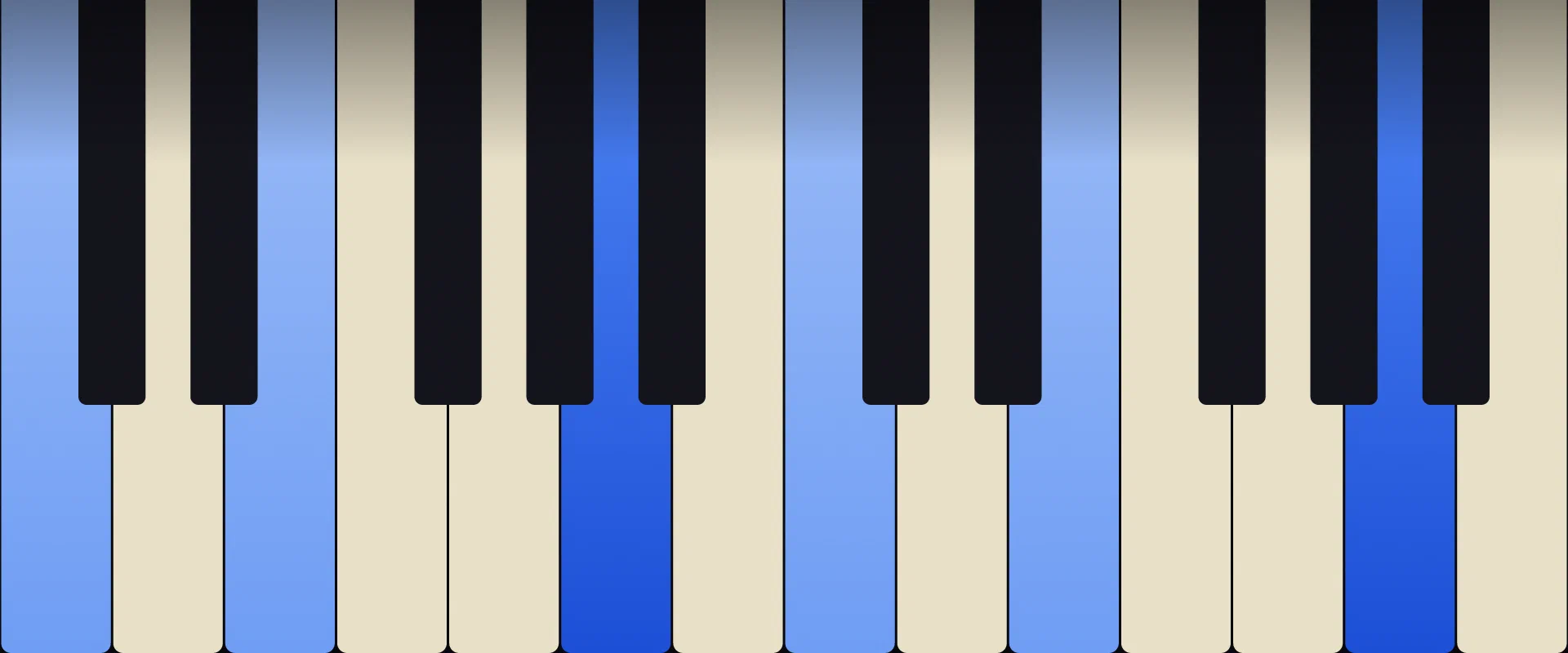
A minor is the one minor key whose signature is blank. No sharps, no flats, and a tonic triad of three white keys: A, C and E. That piece of notational housekeeping has done more for the chord than anything about how it sounds. When a textbook needs to show what a minor triad is, it prints this one, for exactly the reason it prints C major when it needs a major triad, and the two are not merely neighbours in that habit. They are the same seven notes seen from opposite ends, so half of learning A minor is learning what stops those notes sounding like C major instead. Guitarists arrive from elsewhere: Am is a three finger first position shape sitting one finger from A major on one side and one finger from Am7 on the other.
Try It: Am in the Chord Finder
Set the root to A and choose the minor triad. All three notes land on white keys.
The Notes of Am
| Degree | Note | Interval from root | Semitones |
|---|---|---|---|
| 1 (root) | A | Perfect unison | 0 |
| ♭3 | C | Minor 3rd | 3 |
| 5 | E | Perfect 5th | 7 |
Written out: A, C, E. Three of the twelve minor triads need no accidental, on A, D and E, but A minor is the only one whose key signature is empty as well, so it is the single case where the chord and the key it governs are both clean.
How Am Is Built
A up to C is three semitones, a minor 3rd. C up to E is four, a major 3rd. The outer interval, A to E, is the same perfect 5th that A major has, which is the point of the comparison: the two chords share their frame and disagree only about the note in the middle.
Raise the C to C♯ and the chord becomes A major. Lower the E to E♭ instead and you have A diminished. Put G on top for Am7, the version most players actually reach for, or G♯ for AmMaj7, the tonic seventh A harmonic minor supplies.
Am on the Piano
The chord straddles both black key groups without touching either. A is the white key wedged between the second and third keys of the group of three, C sits immediately left of the group of two, and E immediately right of it. Right hand 1, 3 and 5, left hand 5, 3 and 1, and the wrist stays level throughout because no finger reaches back between raised keys.
The exercise worth doing first teaches the relative pair by touch. Play C, E and G with the right hand, then move the little finger up one white key from G to A. You now have C, E and A, which is A minor in first inversion. One finger, one step, and the mood has changed completely while two of the three notes never moved. Rock between those grips until your ear stops needing to be told which is which. That single voice moving by a step is also how the vi chord is approached in real music, so the drill is a voicing lesson as much as an ear one.
One caution: the minor 3rd from A up to C is narrow, and placed low it clouds faster than a major 3rd does. Keep A2 and C3 apart, root alone in the left hand and the upper two in the right.
Am on the Guitar
The open form is x 0 2 2 1 0, and it is noticeably kinder than the A major shape it resembles. A major asks three fingertips to occupy one fret column across three adjacent strings, roughly 15 mm of space. A minor takes the finger on the B string and moves it back to the 1st fret. The block becomes a diagonal, the fingers stop competing for one lane, and the ring finger gets room to arch clear of the open first string. Beginners who fight A major usually find A minor lands first, despite both needing three fingers.
Low to high the chord sounds A, E, A, C, E. The root is the open fifth string, so unlike the open C shape it is grounded without anyone fretting a bass note. The sixth string is damped by the thumb hooked over the neck.
What makes the shape worth living in is what surrounds it. Lift the finger off the B string for Asus2, x 0 2 2 0 0. Move that same finger up one fret instead for A major, x 0 2 2 2 0. Lift the finger off the G string for Am7, x 0 2 0 1 0. Three chords from one shape, each a single finger away, with the hand never leaving the first two frets. Little else on the instrument is arranged this conveniently, and a great deal of folk and rock guitar writing is downstream of that accident.
Away from the nut, A minor is the Em shape barred at the 5th fret, 5 7 7 5 5 5, where the frets are still wide and the string tension is well below what the 1st fret demands. The open form is also the CAGED Am shape in its home position, the template for every minor barre chord rooted on the fifth string.
Inversions
| Inversion | Notes | Bass | Symbol |
|---|---|---|---|
| Root position | A C E | A | Am |
| 1st inversion | C E A | C | Am/C |
| 2nd inversion | E A C | E | Am/E |
Am/C is the relative pair made physical. Its bass and its lower two notes are identical to C major and only the top note differs, which is why a progression can slide between C and Am without the bass moving at all. Guitarists get it for one finger, x 3 2 2 1 0.
Am/E is free on the guitar. Stop muting the sixth string, play 0 0 2 2 1 0, and the open low E becomes the bass, giving a hollower, less settled chord that suits a melody which has not arrived anywhere yet.
Voicings
| Voicing | How to play it |
|---|---|
| Open Am | x 0 2 2 1 0, the standard first position shape |
| Am7 | x 0 2 0 1 0, one finger lifted |
| Asus2 | x 0 2 2 0 0, hovering between major and minor |
| Barre at the 5th fret | 5 7 7 5 5 5, Em shape moved up |
| Am/C | x 3 2 2 1 0, C in the bass |
| Am/E | 0 0 2 2 1 0, open low E in the bass |
| Piano, spread | A2 in the left hand, C4, E4 and A4 in the right |
Doubling A at the top rather than E keeps the spread piano voicing rooted, and the octave of air below stops the narrow 3rd clouding.
Which Keys Contain Am
- i of A natural minor
- i of A harmonic minor
- vi of C major
- ii of G major
- iii of F major
- iv of E natural minor
The first three matter most. A minor and C major contain identical notes, so this chord is tonic of one and vi of the other at the same time. A harmonic minor is where the difference gets manufactured: it raises G to G♯, turning the dominant into E major.
Where Am Shows Up
| Progression | In this key | Chords |
|---|---|---|
| i, iv, V | A minor | Am, Dm, E7 |
| i, ♭VII, ♭VI, V | A minor | Am, G, F, E |
| I, V, vi, IV | C major | C, G, Am, F |
| ii, V, I | G major | Am7, D7, G |
Which of C major and A minor you are actually in is not decided by the notes, because they are the same notes. It is decided by which chord the phrase starts and ends on, whether the bass keeps returning to A, and above all whether G is raised to G♯. That one accidental produces E major or E7, the only chord nearby with a real pull towards A. Progressions that never raise it, and pop and folk are full of them, hover between the two centres on purpose, which is why so many songs get argued about.
The second row is the Andalusian cadence, and in A minor it is the flamenco progression: Am, G, F, E, descending by step to a major chord on E that sounds like an arrival rather than a departure. Spanish guitar lives there because all four chords fall in the first position and the open strings ring through the whole descent.
Beginner repertoire is dense with this chord for the same structural reason. C, Dm, Em, F, G and Am are all first position shapes, so a whole songbook can be played without a barre. “The House of the Rising Sun” sits in A minor precisely because of that.
The inversions earn their keep too. Holding an A minor while the bass walks down from A through G♯ and G to F♯ is one of the most recognisable openings in rock guitar, and it works because the top of the chord stays put while only the lowest voice moves.
Related Chords
- A Major Chord for the one note that separates them
- C Major Chord for the other half of the relative pair
- Seventh Chords: The Complete Guide for Am7 and AmMaj7
- Suspended Chords: Sus2, Sus4 and Tension for Asus2 and Asus4
- Guitar Chord Shapes: The CAGED System for moving the Am shape up the neck
- Chord Inversions and Voice Leading
Learn More
Practice Chords
Drill chord recognition with a metronome, MIDI support, and score tracking.
Start Practicing