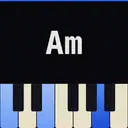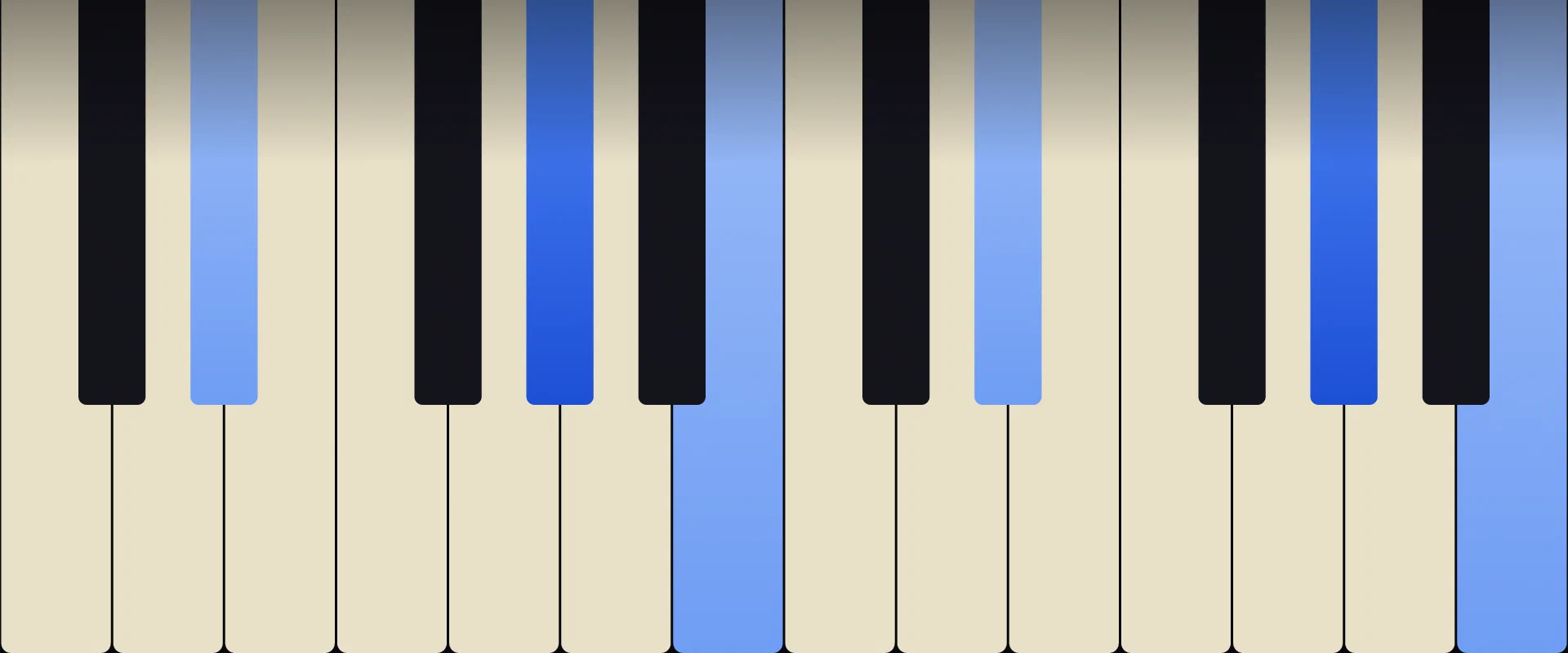
Most players have fingered this chord hundreds of times without ever seeing it written this way. On a guitar chart it says G♯m, and in a rock song in E major nobody gives it a second thought. The name A♭m appears when the music around it is already in flats: the borrowed minor iv in an E♭ major ballad, the iv chord of E♭ minor, a gospel or horn chart where every other chord carries a flat. Same three keys under the hand, different name on the page, and a spelling that sends readers back to the keyboard to check whether the page is wrong.
Try It: A♭m in the Chord Finder
The Notes of A♭m
| Degree | Note | Interval from root |
|---|---|---|
| 1 | A♭ | Perfect unison |
| ♭3 | C♭ | Minor 3rd, 3 semitones |
| 5 | E♭ | Perfect 5th, 7 semitones |
Written low to high in root position: A♭ C♭ E♭.
C♭ is played on the white key B. That is not a misprint, and it is the single thing about this chord worth understanding properly. A triad always uses alternate letters, so a chord rooted on A is spelled on A, C and E, because C is the third letter above A and E is the fifth. Whatever accidentals the chord needs, the letters cannot move. The minor 3rd above A♭ sounds like B, but the letter has to be a C, so it is written C♭.
Spell it A♭ B E♭ instead and the chord has no C in it, so it stops looking like a triad on the page, and A♭ up to B has to be read as an augmented 2nd. Same sound, different interval, and the rules about what a chord may do next are written in intervals, not in keys pressed.
The same logic explains why the KEY is usually called something else. A♭ minor needs seven flats (B♭, E♭, A♭, D♭, G♭, C♭ and F♭), two of which land on white keys. G♯ minor covers the identical pitches with five sharps, so publishers set the key signature in G♯ minor. The chord, though, keeps the spelling of its surroundings, and in flat surroundings that spelling is A♭m.
How A♭m Is Built
Take A♭ major, A♭ C E♭, and drop the middle note a semitone. C becomes C♭, and your finger slides from the white key C down to the white key B. Nothing else moves: the outer shell A♭ and E♭ decides what the chord is called, the note between them decides its mood. Read from the sharp side, the same three keys are G♯ B D♯, which is what a guitarist expects to see. Neither spelling is wrong.
A♭m on the Piano
Two black keys, one white. A♭ and E♭ sit at the outside exactly as they do in A♭ major, and moving the middle note shifts the balance of the hand more than you would expect. In A♭ major the gap from thumb to third finger is a major 3rd with a minor 3rd above it. Here that is reversed: A♭ up to C♭ is the narrow one and C♭ up to E♭ the wide one, so the cramped interval sits at the bottom where the thumb has least room.
Right hand root position is 1 on A♭, 3 on C♭, 5 on E♭, left hand 5, 3, 1. Because B has no black key directly above it, the third finger can strike it well back, at the same depth as the two black keys the thumb and little finger hold. Keep the hand forward towards the fallboard and all three fingers land in one plane; play B near the front edge and the hand zigzags in and out for a chord that does not require it.
The reading problem is separate from the playing problem. Your fingers cannot tell A♭ C♭ E♭ from G♯ B D♯, but your eyes can, and in seven flats the C♭ and F♭ of the surrounding scale keep landing on white keys while instinct says an accidental means a black one.
A♭m on the Guitar
There is no open form, but there is one open string worth knowing about: the second string sounds B, which is this chord’s C♭. A chord whose root carries an accidental rarely gets its third handed to it by an open string, and this one does. Fret 4 on the low E, fret 1 on the D string, fret 4 on the G string and the B string left open gives A♭ E♭ C♭ C♭ with three fingers and a ring the barre shapes never produce.
The workhorse is the Em shape barred at the 4th fret, fingered 4 6 6 4 4 4. That position is kind to the hand: the string tension has dropped off from where it is at the 1st fret and the frets are still wide enough that the barre finger need not be precise. Guitarists in E, B or F♯ major hold this shape constantly, calling it G♯m.
The Am shape barred at the 11th fret, x 11 13 13 12 11, covers the same chord an octave up. It is thinner, the frets are cramped that far along, and on most acoustics the body is in the way. Save it for when the chords either side of it also sit high.
For a song in E♭ minor, a capo beats either barre. Put it at the 4th fret and play in B minor: the Bm shape sounds E♭m, the Em shape sounds A♭m, the F♯ shape sounds B♭. A whole minor key of comfortable chords, with the iv reduced to a plain Em fingering.
Inversions
| Inversion | Notes low to high | Bass note |
|---|---|---|
| Root position | A♭ C♭ E♭ | A♭ |
| 1st inversion | C♭ E♭ A♭ | C♭ |
| 2nd inversion | E♭ A♭ C♭ | E♭ |
First inversion puts the thumb on the one white key with both black keys above it, the most comfortable grip of the three. Second inversion earns its place when A♭m is the iv chord of E♭ minor: E♭ is already the tonic, so keeping it in the bass makes the chord a colour over a pedal rather than a departure from home.
Voicings
Pianists rarely stack all three notes in one fist here. Left hand takes A♭ and E♭ as a bare shell, right hand takes C♭ E♭ A♭, and the awkward note ends up buried in the middle of the texture.
Adding a 7th gives A♭m7 (A♭ C♭ E♭ G♭), which is how the chord almost always appears in gospel and soul. A♭m(maj7) (A♭ C♭ E♭ G) is the line cliché chord, G falling to G♭ over a held A♭m. On guitar the useful reduction is the A♭5 shell at the 4th fret.
Which Keys Contain A♭m
- IV of E♭ natural minor
- IV of E♭ harmonic minor
- I of G♯ natural minor
- VI of B major
- III of E major
- V of C♯ natural minor
The first two write the chord with flats. The last three write the same sound as G♯m.
Where A♭m Shows Up
The dividing line is who chooses the key. Singers and horn sections push music towards flats, guitarists push it towards sharps, and this chord sits on the fault line. As G♯m it is vi of B major, iii of E major and ii of F♯ major. As A♭m it belongs to piano, organ and brass.
| Progression | In letters | Where it lives |
|---|---|---|
| I, IV, iv, I | E♭, A♭, A♭m, E♭ | The minor four, ballads and doo wop |
| i, iv, V7, i | E♭m, A♭m, B♭7, E♭m | E♭ minor, cadence from the harmonic minor |
| I, v7, I7, IV | D♭, A♭m7, D♭7, G♭ | Gospel and soul turnaround |
The first is where most listeners have met this chord without knowing it. A♭ major arrives, then darkens as C sinks to C♭, and the pull back to E♭ becomes irresistible. One semitone of movement, doing more work than any other single note in popular harmony.
The second shows why the chord keeps company with the harmonic minor. Plain E♭ minor gives B♭m as its V chord, which resolves weakly; borrowing the D natural of E♭ harmonic minor turns it into B♭7 and the cadence lands. A♭m is the chord that sets it up.
The third is a keyboard player’s move and the clearest argument for the flat spelling. In D♭ major, A♭m7 is the minor v, a chord with no business in a major key that turns up in gospel constantly, sliding to D♭7 and then to G♭. Written G♯m7 in the middle of a D♭ chart it would be unreadable.
Related Chords
- A♭ Major Chord for the same root with C instead of C♭
- Minor Scales: Natural, Harmonic and Melodic for where the B♭7 in that cadence comes from
- Guitar Chord Shapes: The CAGED System for how the Em and Am shapes move up the neck
- G♯ Natural Minor Scale and E♭ Natural Minor Scale
Learn More
Practice Chords
Drill chord recognition with a metronome, MIDI support, and score tracking.
Start Practicing