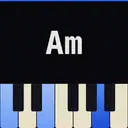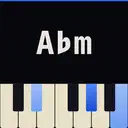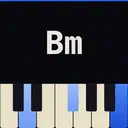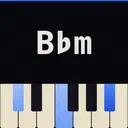
Gm is where a guitarist runs out of open strings. Am, Em and Dm all sit at the nut and cost a finger or two. Gm has no open form at all, because the six open strings supply G, B and D but not a single B♭. The third has to be fretted, which in practice means a barre at the 3rd fret from the first bar of the chart.
The chord is nonetheless everywhere. Gm is the ii of F major and the vi of B♭ major, the two keys a horn section treats as home, so it lands on the music stand far more often than its cost on the fretboard would suggest. Its three notes are G, B♭ and D: two white keys and one black.
Try It: Gm in the Chord Finder
The Notes of Gm
| Degree | Note | Interval from Root | Semitones |
|---|---|---|---|
| 1 (Root) | G | Perfect unison | 0 |
| ♭3 | B♭ | Minor 3rd | 3 |
| 5 | D | Perfect 5th | 7 |
Written Gm, Gmin or G-, and the spelling never varies. The third is always B♭ and never A♯, because a triad stacks letters in thirds and G needs a B of some kind above it.
How Gm Is Built
Take G major, G B D, and drop the middle note a semitone. B becomes B♭ and the quality flips with one move. The root and the perfect 5th do not budge, which is why the change is so easy to hear: one pitch has moved, by the smallest distance available.
Below Gm sits G5, the bare G and D power chord. It has no third and therefore no quality, which is why a riff built on G5 works over both a major and a minor tune. Adding B♭ commits you; adding F on top gives Gm7, the workhorse ii chord of every jazz standard in F.
The key signature of G minor carries two flats, but the triad needs only B♭. E♭ arrives with the ♭6, and so does the pull towards E♭ major or C minor.
Gm on the Piano
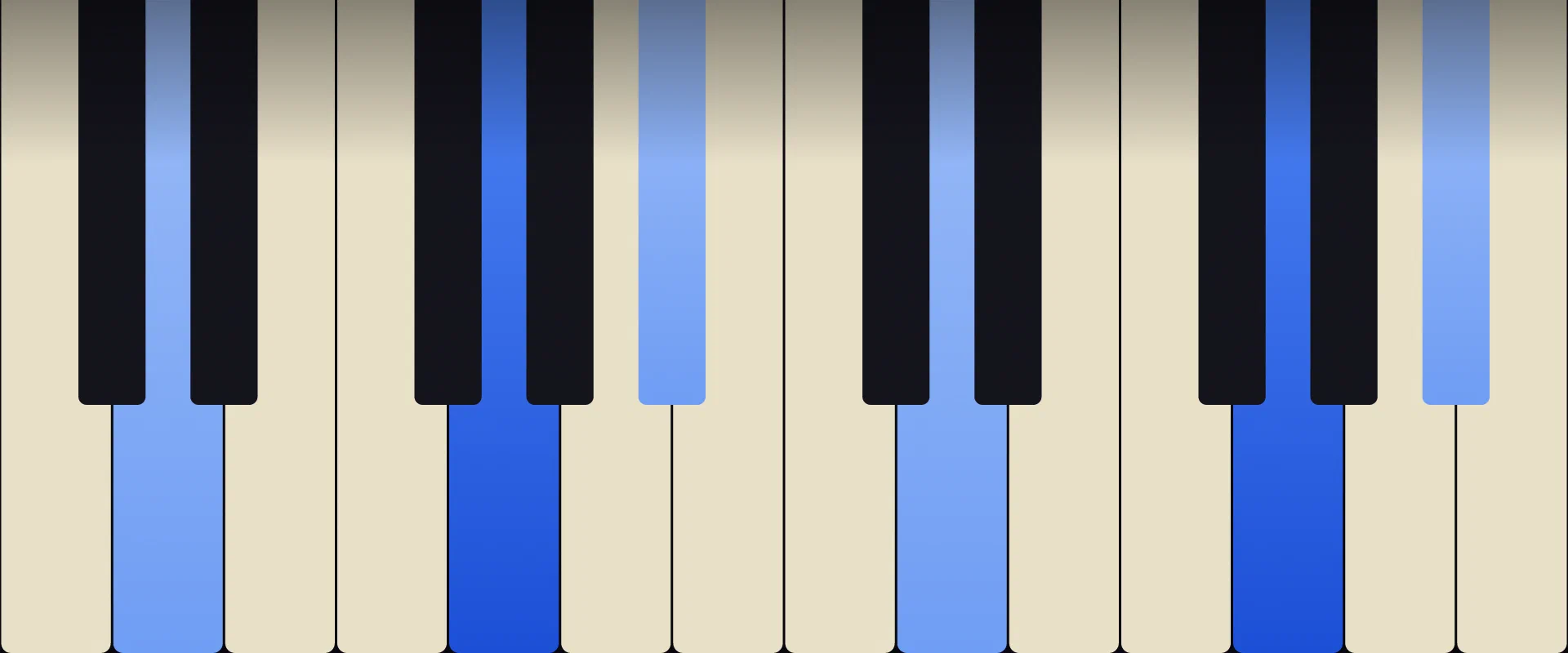
One black key, and it is the middle note. G and D are white; B♭ is the top key of the group of three blacks. The hand therefore climbs backwards and up for the third, then forwards again for the fifth.
Right hand: 1 on G, 3 on B♭, 5 on D. Left hand: 5, 3, 1. The middle finger is the longest of the five, so setting it on the black key that sits further back is anatomically comfortable. Gm supports the hand better than an all white triad does, because the raised third gives finger 3 somewhere natural to rest instead of letting the wrist flatten.
Register deserves more attention than fingering here. A minor 3rd spans only three semitones, so G with B♭ played low, around G2, puts two pitches close enough that their overtones beat and the chord growls. Orchestral writing in this key leaves the bass alone on G and stacks B♭ and D well above it. Do the same: G and D in the left hand, B♭ and D in the right, above middle C.
Two voice leading moves are worth memorising. From G B♭ D, hold B♭ and D and drop the bottom G a tone to F: that is B♭ major in second inversion, the relative major reached with one finger. Or hold G and B♭ and lift D a semitone to E♭, giving E♭ major over G, the i to VI step behind a great deal of film and pop writing in this key.
Gm on the Guitar
The full form is the E minor shape barred at the 3rd fret, 3 5 5 3 3 3, index flat across all six strings with the ring and little fingers on the 5th and 4th. Three frets up the strings are still tight and the fret is still wide, so the barre takes genuine grip, though it is kinder than the same shape at the nut.
Most players find the shortcut by accident. Fret the top three strings at the 3rd fret, let the D string ring and mute the bottom two: x x 0 3 3 3 sounds D, B♭, D, G. Every pitch belongs to the chord, the open D makes it a second inversion, and it sits better in a busy mix than the six string version, which has a low third muddying the bass.
Higher up, the A minor shape barred at the 10th fret puts the root on the 5th string: x 10 12 12 11 10. The frets are cramped there and the voicing is thin and bright, which suits stabs rather than a full rhythm part.
Then there is the dodge most singer songwriters use. Clamp a capo at the 3rd fret and every E minor shape becomes a G minor one: Em sounds as Gm, Am as Cm, G as B♭, C as E♭, D as F and B7 as D7. The whole key is suddenly available in the easiest minor shapes on the instrument, with open strings ringing through it, and that chiming unbarred quality is audible on record. The cost is everything below the 3rd fret, so a bass line descending under the tonic is simply gone.
Inversions
| Inversion | Notes | Bass | Symbol |
|---|---|---|---|
| Root position | G B♭ D | G | Gm |
| 1st inversion | B♭ D G | B♭ | Gm/B♭ |
| 2nd inversion | D G B♭ | D | Gm/D |
Gm/B♭ is deliberately ambiguous: B♭ D G is equally readable as B♭6, so the same three notes are i in G minor or vi in B♭ major depending on what follows. Composers pivot between the keys on that pun.
Gm/D is the shape the guitar hands you free at x x 0 3 3 3, and the cadential six four of G minor: hold the tonic over a D bass, let it fall into D major, and the dominant arrives with weight.
Voicings
The barre voicing reads upwards as G, D, G, B♭, D, G: three roots, two fifths and one solitary third buried in the middle. Fifth heavy and hollow, good for driving rhythm parts. The three finger version, D, B♭, D, G, puts the third high where the ear can find it, so it reads as unmistakably minor at a fraction of the effort.
At the piano, G and D in the left hand with B♭, D and G in the right. If a bass player has the root, drop it: B♭ and D alone still spell the chord. Jazz pianists comp Gm7 as a rootless shell of B♭ and F and let the third and seventh do the identifying.
Which Keys Contain Gm
Gm sits in six common keys:
- i of G natural minor
- ii of F major
- iii of E♭ major
- iv of D natural minor
- v of C natural minor
- vi of B♭ major
F, B♭ and E♭ are neighbours on the flat side of the circle of fifths, and G minor is the relative minor of B♭. One chord therefore serves as a tonic, a supertonic and a submediant, all in keys a wind player considers easy and a guitarist does not.
Where Gm Shows Up
| Progression | Chords | Typical use |
|---|---|---|
| i, VI, III, VII | Gm, E♭, B♭, F | Pop and film minor loop |
| i, iv, V | Gm, Cm, D | Classical G minor, F♯ required |
| ii, V, I in F | Gm7, C7, F | Jazz standards |
| vi, IV, I, V in B♭ | Gm, E♭, B♭, F | Ballads and gospel |
| iv, V, i in D minor | Gm, A, Dm | Folk and baroque |
| i, VII, VI, V | Gm, F, E♭, D | Andalusian cadence |
The first and fourth rows use the same four chords and mean different things. Heard from G, Gm, E♭, B♭ and F make a minor loop that never resolves; heard from B♭ they are a plain pop turnaround. The bass and the melody decide which, not the chords.
The transposition arithmetic explains the rest. Concert G minor reads as A minor to a B♭ trumpet or tenor saxophone and as E minor to an alto, the two most comfortable minor keys those players know, while the guitarist reading the same chart is barring at the 3rd fret. That mismatch is why big band and soul charts sit in Gm, Cm and Fm, why guitar led songs sit in Em and Am, and why the capo was invented.
Strings pull the same way. Violin, viola and cello are tuned in fifths, and the violin’s lowest two strings are G and D, the tonic and dominant of this key, so a G minor chord sets them ringing in sympathy. That resonance is a large part of why the key recurs in orchestral writing: Mozart chose G minor for both of the minor key symphonies he wrote, No. 25 and No. 40, and Bach’s most played short organ fugue, BWV 578, is in it too.
Related Chords
- G Major Chord, the same root with B in place of B♭
- G diminished, Gm with the fifth flattened as well, which turns a stable minor chord into one that has to resolve
- Seventh Chords: The Complete Guide for Gm7 and GmMaj7
- Extended Chords and Jazz Harmony for Gm9 and Gm11
- Suspended Chords: Sus2, Sus4 and Tension for the chords either side of the third
- The G Natural Minor Scale
- The G Harmonic Minor Scale
- The G Dorian Scale
- The G Minor Pentatonic Scale
- Guitar Chord Shapes: The CAGED System
Learn More
Practice Chords
Drill chord recognition with a metronome, MIDI support, and score tracking.
Start Practicing