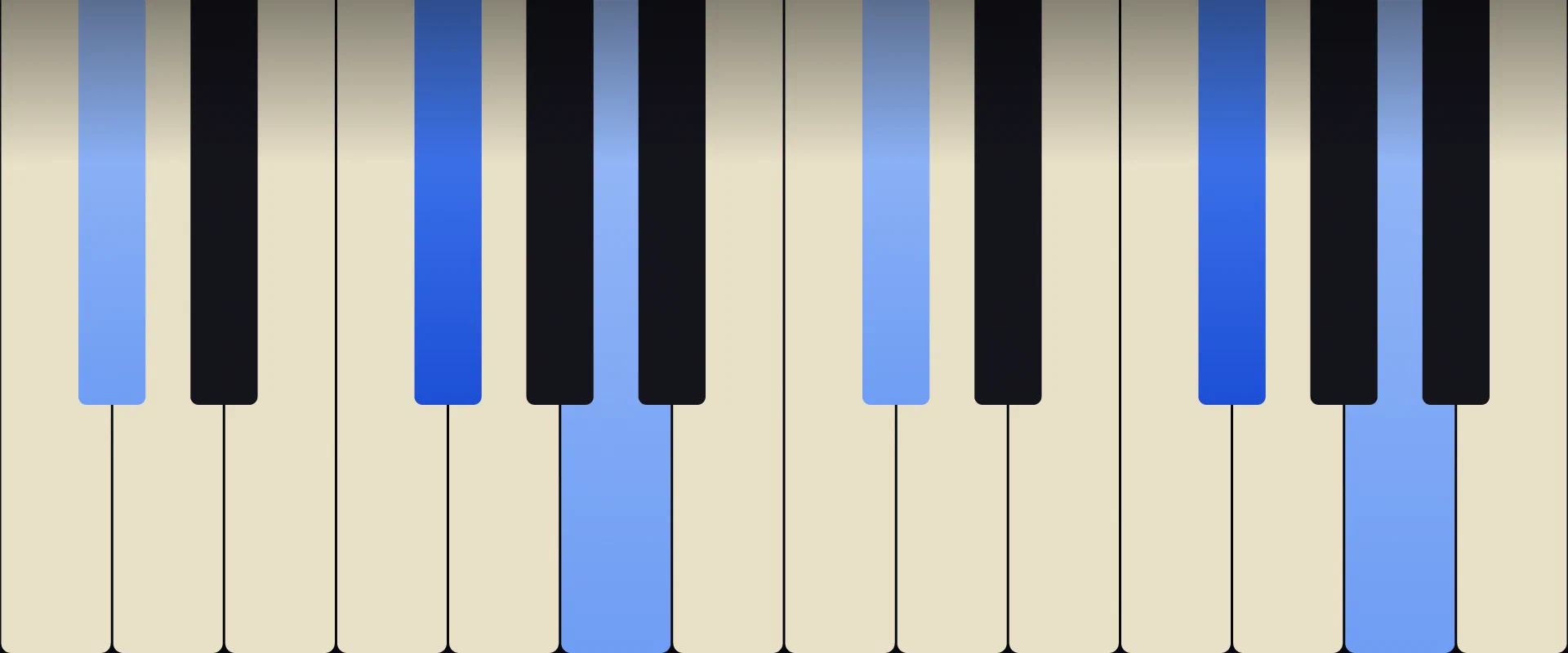
Most guitarists meet F♯ minor long before they can play it. It is the vi of A major, and A major is a key assembled almost entirely from open shapes, so this chord tends to arrive in bar four of a song whose other three chords were learned in week one. Nothing open will cover it. Not one string can be left ringing.
What rescues it is which barre it asks for. Slide the open E minor shape up two frets and the chord is there, needing only two fingers behind the barre where the E major shape needs three. F♯ minor is usually the chord that shows a player the E minor grip moves at all, a far gentler lesson than the one F major delivers one fret lower.
Try It: F♯m in the Chord Finder
The Notes of F♯m
F♯ minor contains three notes.
F♯, A, C♯
| Degree | Note | Interval from root | Semitones |
|---|---|---|---|
| 1 | F♯ | Root | 0 |
| ♭3 | A | Minor 3rd | 3 |
| 5 | C♯ | Perfect 5th | 7 |
The third carries no accidental at all, which is worth noticing in a chord whose root and fifth are both sharps. That bare A is the note a player has to protect: sharpen it and the chord becomes F♯ major. The key takes three sharps, F♯, G♯ and C♯, the same signature as A major, and the chord uses two of them.
How F♯m Is Built
Stack a minor 3rd under a major 3rd: F♯ up to A is three semitones, A up to C♯ is four, and the perfect 5th spans the pair.
The nearest simpler chord is F♯ major, F♯, A♯ and C♯. Lower the middle note a semitone and A♯ becomes A natural. On a keyboard that is a finger stepping off a black key onto the white key beside it, turning the only all black major triad into a chord with a white note in the middle.
Add E above the fifth and you have F♯m7, the version most jazz and soul charts actually want.
F♯m on the Piano
Black, white, black. F♯ and C♯ are raised keys and A sits between them on the white row, so the hand is not flat and not fully forward but somewhere between the two. Right hand 1 on F♯, 3 on A, 5 on C♯; left hand 5, 3, 1.
The trick is where the middle finger plays. A is a white key hemmed in by G♯ and A♯, and its rear portion, the narrow strip between those two black keys, lines up with the thumb and little finger. Play A there rather than out on the wide front lip and all three fingers sit at one depth, the wrist stays level, and the chord can be dropped on blind.
This is the easier of the two F♯ triads. Three black keys ask the thumb to perch on a narrow surface; here it still does, but the middle finger has somewhere broad to land and that steadies the whole shape.
Reading holds no traps in the chord itself. It does in the key. F♯ harmonic minor raises its seventh to E♯, so the dominant here is C♯ major, C♯, E♯ and G♯, and E♯ is played on the white key F. A reader meeting that spelling for the first time stops dead, then finds the hand was already in the right place.
F♯m on the Guitar
There is no open F♯ minor, yet the key it heads is one of the most comfortable on the instrument. F♯ natural minor is F♯, G♯, A, B, C♯, D and E, which means five of the six open strings belong to it. Only the G string is foreign. The tonic chord has to be fretted while almost everything around it can ring.
The standard grip is the E minor shape at the 2nd fret: 2 4 4 2 2 2 low to high, index barred across all six strings, middle finger on the 5th string and ring finger on the 4th. Two fingers behind the barre, and the little finger is free the whole time.
That is why players find this chord easier than F major even though both are full barres near the nut. F major moves the E major shape, three fingers behind the barre, with the index doing precise work at the 1st fret where the string is shortest, stiffest and highest off the board. One fret up there is more give, less height to fight, and one finger fewer competing for hand pressure.
Lift the ring finger off the 4th string and 2 4 2 2 2 2 gives F♯m7, one of the cheapest useful chords on the neck. The A minor shape at the 9th fret, x 9 11 11 10 9, is the alternative: closer frets, lower action, less force, and it keeps the chord clear of a bass part.
Inversions
| Inversion | Notes | Bass note |
|---|---|---|
| Root position | F♯ A C♯ | F♯ |
| 1st inversion | A C♯ F♯ | A |
| 2nd inversion | C♯ F♯ A | C♯ |
First inversion is where this chord turns slippery. With A in the bass it sits one note away from A major, its own relative major, and the ear cannot always decide which of the two is home. That ambiguity keeps loops built on the pair turning instead of resolving. See Chord Inversions and Voice Leading for how the bass note steers the meaning.
Voicings
Keep the left hand to F♯ and C♯, a bare fifth, and let the right carry A, C♯ and F♯ above it. The A then sounds as colour rather than weight, which suits a chord whose third does all the work. Adding E at the top gives F♯m7 without moving anything else.
On guitar, x x 4 6 7 5 is a compact voicing on the top four strings with the A ringing above everything. Drop the third and 2 4 4 x x x is the F♯5 power chord, useful when distortion would smear the A anyway.
Which Keys Contain F♯m
| Degree | Key |
|---|---|
| iii | D major |
| ii | E major |
| vi | A major |
| i | F♯ natural minor |
| iv | C♯ natural minor |
| v | B natural minor |
D, E and A are the three keys guitarists live in, and F♯ minor is diatonic to all three. That one fact explains why a chord with no open form gets played more than most chords that have one.
Where F♯m Shows Up
A, E, F♯m, D. The I, V, vi, IV loop in A major, and probably the most played progression in guitar based popular music. Three of the four are open chords learned early. The fourth is this one, which is why so many players date their first working barre to a song in A.
F♯m, B7, E. A ii, V, I in E major, and in a jazz setting F♯m7, B7, Emaj7. E is a guitar key and a horn player’s least favourite, which is one of the clearest cases where a tune gets transposed on the way from a band to a chart. See How to Transpose a Song to Any Key.
F♯m, C♯7. The i and V of F♯ minor itself, the E♯ inside that dominant borrowed from harmonic minor. This is the key asserting itself instead of leaning on its relative major, common in metal, in flamenco influenced guitar and in film cues.
One curiosity of tuning. On guitar the open G string is the only one outside F♯ natural minor, and on violin, tuned G, D, A and E, the open G is again the only one outside it. Two instruments strung on entirely different principles stumble on the same note.
Related Chords
- F♯ Major Chord, the same root with A♯ in place of A
- A Major Chord, the relative major and its constant companion
- Seventh Chords: The Complete Guide for F♯m7 and F♯mMaj7
- Extended Chords and Jazz Harmony for F♯m9 and F♯m11
- Guitar Chord Shapes: The CAGED System for the other positions that produce this chord
Learn More
- Minor Scales: Natural, Harmonic and Melodic, and why the dominant of F♯ minor needs E♯
- Diatonic Chords: A Beginner’s Guide, for why the sixth degree of a major key is minor
- The Circle of Fifths Explained, where F♯ minor and A major share a slot
- The F♯ Natural Minor Scale, the parent key of this chord
Practice Chords
Drill chord recognition with a metronome, MIDI support, and score tracking.
Start Practicing