Fm clears F major’s name. It sits at the same 1st fret, under the same full barre, in the same place by the nut where the strings have the least give, and plenty of guitarists can hold it a week or two before they can hold F. The difference is countable. The E shape needs three fingers behind the barre; the Em shape needs two. Lift the middle finger off the 3rd string of an F chord and the barre underneath is already pressing A♭. One finger leaves the neck and F major turns minor.
The keyboard reverses that verdict. F, A♭ and C puts a single black key between two white ones and asks the middle finger to climb, so the hand tilts where F major sat level. Neither instrument finds this chord difficult, but the two disagree about which F triad is the easier one.
Try It: Fm in the Chord Finder
Set F as the root and switch between the keyboard and the fretboard. A♭ is the only note that moves when you compare F with Fm.
The Notes of Fm
| Degree | Note | Interval from Root | Semitones |
|---|---|---|---|
| 1 (Root) | F | Perfect unison | 0 |
| ♭3 | A♭ | Minor 3rd | 3 |
| 5 | C | Perfect 5th | 7 |
F up to A♭ is three semitones, A♭ up to C is four. The small interval sits underneath, which is what minor means. The outer F to C is a perfect 5th, identical in both F triads.
How Fm Is Built
Play F major and lower the A a semitone. That is the whole edit. Nothing else moves, so a song can slide between the two chords without the bass player noticing anything happened.
A♭ also fixes the chord’s address. F minor carries four flats, B♭, E♭, A♭ and D♭, so Fm arrives in the company of D♭ and G♭ rather than of D and G.
Fm on the Piano
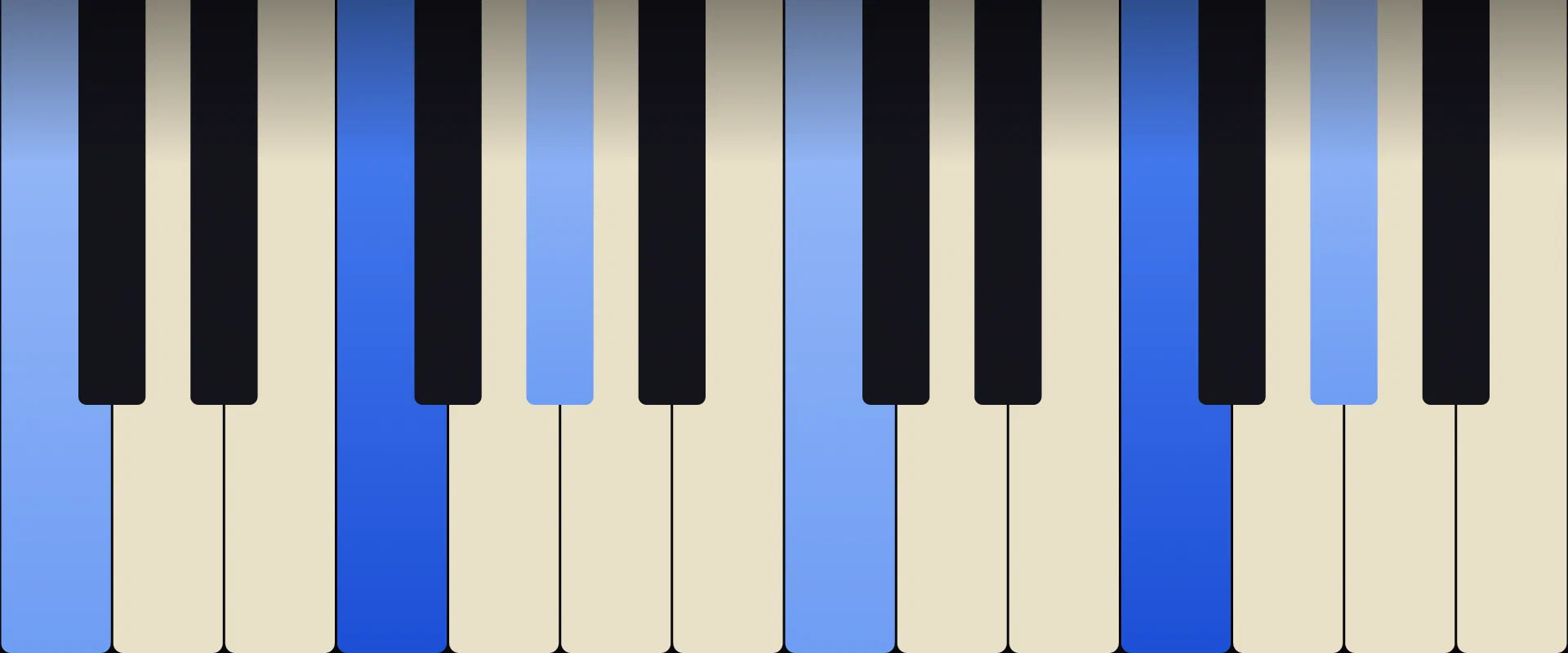
One black key, and it is the middle one of the group of three. Thumb on F, the white key immediately left of that group. Middle finger on the black key at the centre of it. Little finger on C, the white key just left of the next pair of blacks. Right hand 1, 3, 5. Left hand 5, 3, 1.
The middle finger now sits deeper into the keyboard than its two neighbours, so the hand no longer lies flat the way it does on F major. Let the wrist rise a little and let the thumb and little finger play nearer the outer ends of their keys. Trying to keep all three fingertips in a straight line is what makes this shape feel cramped.
Because one finger separates the two chords, F to Fm is a good drill for the third finger alone. Hold F and C down and rock the middle finger between A and A♭ until the black key stops feeling like a detour. Pianists meet this key early for reasons unrelated to difficulty: the sonata repertoire is full of it. Beethoven’s first published sonata, Op. 2 No. 1, is in F minor, and the Appassionata returns to it.
Fm on the Guitar
The full chord is the Em shape barred at the 1st fret. Index flat across all six strings, ring finger on the 5th string at fret 3, little finger on the 4th string at fret 3. Strings 3, 2 and 1 are left to the barre alone. Low to high, that is 1 3 3 1 1 1.
Two fingers shape the chord instead of three, and the one that has gone is the awkward one: the middle finger that had to reach across to fret 2 for F major. What remains is a barre with a two note block sitting on top of it, which is easier to place accurately and easier to keep clean.
The cut down forms are unusually good here. Barre only the top three strings at fret 1 and strum them: A♭, C and F, a complete F minor chord from one finger. Add the ring finger on the 4th string at fret 3 for x x 3 1 1 1 and the root goes underneath, still two fingers in total. Both equivalent F major shapes need an extra finger down at fret 2.
Further up the neck the Am shape at the 8th fret gives the same chord where the strings put up far less resistance, x 8 10 10 9 8. The other standard dodge is a capo at fret 1, which turns the entire open E minor vocabulary, Em, Em7 and Emadd9 included, into F minor at no cost.
Inversions
| Inversion | Notes | Bass Note | Symbol |
|---|---|---|---|
| Root position | F, A♭, C | F | Fm |
| 1st inversion | A♭, C, F | A♭ | Fm/A♭ |
| 2nd inversion | C, F, A♭ | C | Fm/C |
Fm/A♭ is the pivot into the relative major. Those three notes are the bottom of an A♭6, so a bass that steps down to A♭ under a held F minor is already halfway to A♭ major and a single added E♭ completes the move.
Fm/C belongs to C minor, where Fm is the iv chord. Keep C in the bass and the iv can come and go without the bass line moving at all. That is the plagal cadence in its minor form, and it is why so many minor key hymn endings sit still underneath.
Voicings
Keep the bottom of an F minor voicing open. F2 alone underneath A♭3, C4 and F4 stays clear, while F2, A♭2 and C3 packed together turns to mud. The minor 3rd muddies faster than the major one, because its lower overtones start colliding sooner.
| Shape | Frets, low to high | Sounding notes |
|---|---|---|
| Em shape barre, fret 1 | 1 3 3 1 1 1 | F, C, F, A♭, C, F |
| Four string | x x 3 1 1 1 | F, A♭, C, F |
| Three string | x x x 1 1 1 | A♭, C, F |
| Am shape barre, fret 8 | x 8 10 10 9 8 | F, C, F, A♭, C |
Which Keys Contain Fm
- i of F natural minor
- iv of C natural minor
- v of B♭ natural minor
- vi of A♭ major
- ii of E♭ major
- iii of D♭ major
Every one of those six is written with flats, and half of them with four or more. That is the practical fact about this chord: it belongs to the side of the circle guitarists visit least and horn players live on.
Where Fm Shows Up
In C minor, Cm, Fm, G, Cm is i, iv, V, i, and Fm is the chord that darkens the middle of it. Change the G to Gm and the same four bars stop cadencing and start looping, which is the difference between a hymn and a groove.
A♭ major puts the chord in a sunnier setting: A♭, Fm, D♭, E♭ is I, vi, IV, V, and Fm is the bar where the vocal usually turns. Inside F minor itself the default modern loop is Fm, D♭, A♭, E♭, i, VI, III, VII, while a jazz player gets there through Gm7♭5, C7, Fm, a minor ii, V, i.
Transposing instruments explain the rest. A concert F minor chart reads as G minor for a B♭ trumpet or tenor saxophone, two flats, and as D minor for an E♭ alto, one flat. The key that looks forbidding on a guitarist’s page is the comfortable one on a horn player’s, which is why big band, gospel and soul arrangements settle into F minor and A♭ major while guitar bands drift towards E minor and A minor. Capo 1 is the compromise everybody signs: the singer keeps F minor, the guitarist keeps E minor shapes.
Related Chords
- F Major Chord is the same three notes with A in place of A♭, and the harder of the two barre chords.
- A♭ Major Chord is F minor’s relative major and shares two of its three notes.
- Diatonic Chords: A Beginner’s Guide shows how one triad works as a ii, iii, iv or vi depending on the key around it.
- Chord Inversions and Voice Leading goes further into Fm/A♭ and Fm/C.
- Guitar Chord Shapes: The CAGED System explains why the Em shape and the Am shape both land on this chord.
Learn More
F minor sits at the four flat mark on the circle of fifths, sharing its key signature with A♭ major. For Fm7 and Fm9, see Seventh Chords: The Complete Guide and Extended Chords and Jazz Harmony. For every scale that contains this chord, see Scales for Piano and Guitar: The Complete Reference Guide.
Practice Chords
Drill chord recognition with a metronome, MIDI support, and score tracking.
Start Practicing