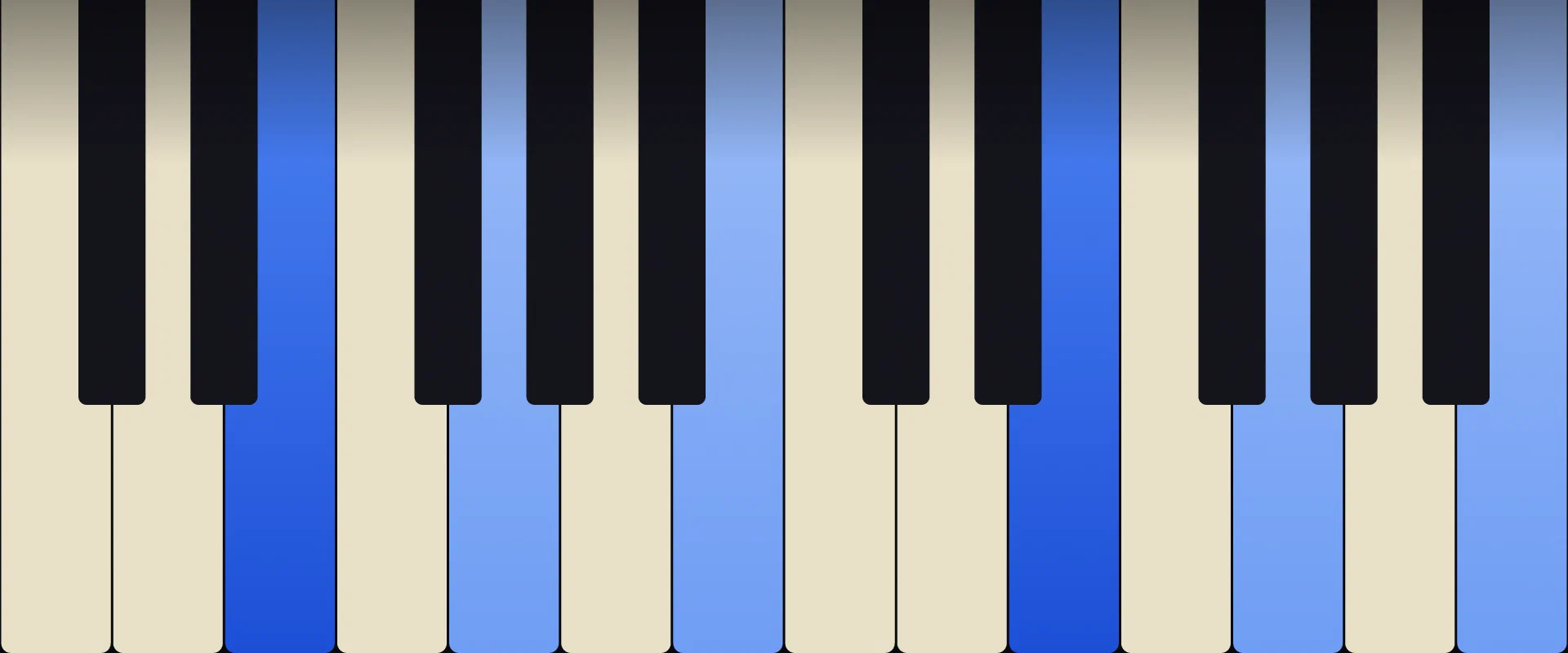
Two fingers, and the other four strings look after themselves. E minor is the cheapest chord on a guitar and nearly always the first one a beginner is shown: the root is the lowest note the instrument owns, the minor third is an open string, all six strings ring, and there is nothing to mute or skip. On a piano the same three notes, E, G and B, are white keys that attract no attention at all. Most of what is interesting here lives in that gap.
Try It: Em in the Chord Finder
Pick E as the root and a minor scale to hear the triad and see what sits beside it.
The Notes of Em
E minor takes the root, minor 3rd and perfect 5th:
E, G and B
| Degree | Note | Interval from Root |
|---|---|---|
| 1 (Root) | E | Perfect unison |
| ♭3 | G | Minor 3rd |
| 5 | B | Perfect 5th |
No accidentals at all. Only three minor triads manage that: A minor, D minor and this one.
How Em Is Built
A minor 3rd from E up to G, three semitones, then a major 3rd from G up to B, four more. The nearest simpler chord is E major, with that G raised a semitone, though the relationship runs backwards on a guitar: E major is this shape plus a finger, so learners meet the minor first and treat the major as the variant. Put a C underneath these three notes and you have Cmaj7; take the D out of G6 and these three are what remain.
Em on the Piano
Three white keys, no reach, no tuck, and no accidental anywhere in the shape.
Right hand: thumb on E, third finger on G, fifth finger on B.
Left hand: fifth finger on E, third finger on G, thumb on B.
Having no black key is a small liability rather than a convenience: chords with an accidental locate themselves, and here there is nothing to feel for. Find E at the right hand edge of the group of two and trust the shape.
Pianists do not meet this chord early anyway. It arrives as the iii of C major, comfortably the least used of the seven diatonic triads, so a keyboard player covers a great deal of repertoire without ever reaching for it. When it does appear it is usually colouring a Cmaj7 or sitting inside a sixth chord on G. The key of E minor gives no trouble at all: one sharp is as gentle as a key signature gets.
Em on the Guitar
The open form is 0 2 2 0 0 0, sounding E, B, E, G, B, E from the bottom up. Three E’s, two B’s, and a single G on the open third string. The note that makes the chord minor is the one note nobody has to fret.
Both fretted notes fall at the same fret on adjacent strings, but the real reason the shape is taught first is that there is no partial barre, no string to skip and no string to deaden. A learner who strums all six gets a correct chord, and that forgiveness matters more than the two fingers do.
Use middle and ring rather than index and middle, however unnatural it feels at first. Keeping the index free means one motion adds E major (index on the third string at the 1st fret) and another lays it flat across the nut for F minor. Slide the grip up behind that barre and you have the E minor shape of the CAGED system: G minor at the 3rd fret, A minor at the 5th, B minor at the 7th, E minor again at the 12th.
The alternative is the A minor shape barred at the 7th fret, x 7 9 9 8 x, root on the fifth string. It sounds thinner and clears the bass by an octave, which is what you want when three low E’s are too heavy for the arrangement.
That open bottom string is also why so many riffs live here. The tonic of E minor is the lowest pitch the instrument produces, so the pedal note is free and the tonic chord is one strum away. Drop D and the lower tunings extend the same logic downwards, each measured from this string.
Inversions
| Voicing | Notes | Bass note |
|---|---|---|
| Root position | E G B | E |
| 1st inversion | G B E | G |
| 2nd inversion | B E G | B |
Guitars are usually stubborn about inversions and this chord is the exception, because both fretted notes sit above the bass string rather than under it. Add a finger at the 3rd fret of the sixth string, 3 2 2 0 0 0, and you have Em/G. Mute that string instead, x 2 2 0 0 0, and the fifth gives you Em/B. One finger added, one lifted, and the bass walks while the chord stays put.
Voicings
- Open form, 0 2 2 0 0 0, six strings, full weight.
- Em7, 0 2 0 0 0 0, one finger rather than two, which reverses the usual order of difficulty.
- E5, 0 2 x x x x, third removed for riff work under distortion.
- A minor shape at the 7th fret, x 7 9 9 8 x, lighter and easier to voice-lead from.
- Top four strings, x x 2 0 0 0, quiet enough to leave room for a bass player.
A minor third takes a low bass better than a major third, so this chord tolerates a close left hand where E major does not. The open guitar form sidesteps the question anyway, keeping its only G an octave clear of the bass.
Which Keys Contain Em
E minor is diatonic to six common keys, three major and three minor:
- iii of C major
- ii of D major
- vi of G major
- i of E natural minor
- v of A natural minor
- iv of B natural minor
G major and E natural minor carry most of the traffic: relative keys sharing one sharp, and between them a huge share of guitar music. Being the ii of D major matters nearly as much, since Em to A to D is a turnaround most players know by touch.
Where Em Shows Up
Em, C, G, D. From E minor that is i, ♭VI, ♭III, ♭VII; from G major it is vi, IV, I, V. Four open shapes inside the first three frets, and starting on the E minor is what tips the loop towards sounding minor at all. Folk-rock, indie and singer-songwriter catalogues stay here because moving it up a semitone costs four barre chords.
Em, D, C, B7. The descent, with the raised leading tone arriving last. B7 is x 2 1 2 0 2, one of very few dominant sevenths open position offers at all, and its presence is why so much flamenco-flavoured rock runs this figure in E rather than somewhere kinder to a singer.
Fiddle tunes. A violin is tuned G, D, A, E, so a player in E minor or E Dorian can drone open strings under the melody throughout. A large slice of the Irish and Scottish session repertoire lives in those two, and a guitarist accompanying it finds the key ready made.
Songs cluster by the instrument they were written on, and this chord is the plainest evidence for it. Guitar-born material piles up in E minor, A minor and D minor, hard rock and metal most of all; piano-born material drifts towards C, F and the flat keys. Three unremarkable white keys on one instrument, a tonic that costs almost nothing on the other.
Related Chords
- E Major Chord: Notes, Voicings, and How to Play It is the same guitar shape with a finger added.
- Seventh Chords: A Complete Guide to maj7, min7, dom7, and More covers Em7 and EmMaj7.
- Suspended Chords: Sus2, Sus4, and the Art of Tension for Esus2 and Esus4, which replace the G instead of raising it.
- Guitar Chord Shapes and the CAGED System for moving this shape up the neck.
Learn More
- Diatonic Chords: A Beginner’s Guide to Building Chords from Scales on why E minor lands where it does above.
- Chord Inversions and Voice Leading on choosing a bass note.
- The Circle of Fifths Explained places E minor’s single sharp in context.
- E Natural Minor Scale: Notes, Chords, and How to Play It is the scale this chord is drawn from.
Practice Chords
Drill chord recognition with a metronome, MIDI support, and score tracking.
Start Practicing