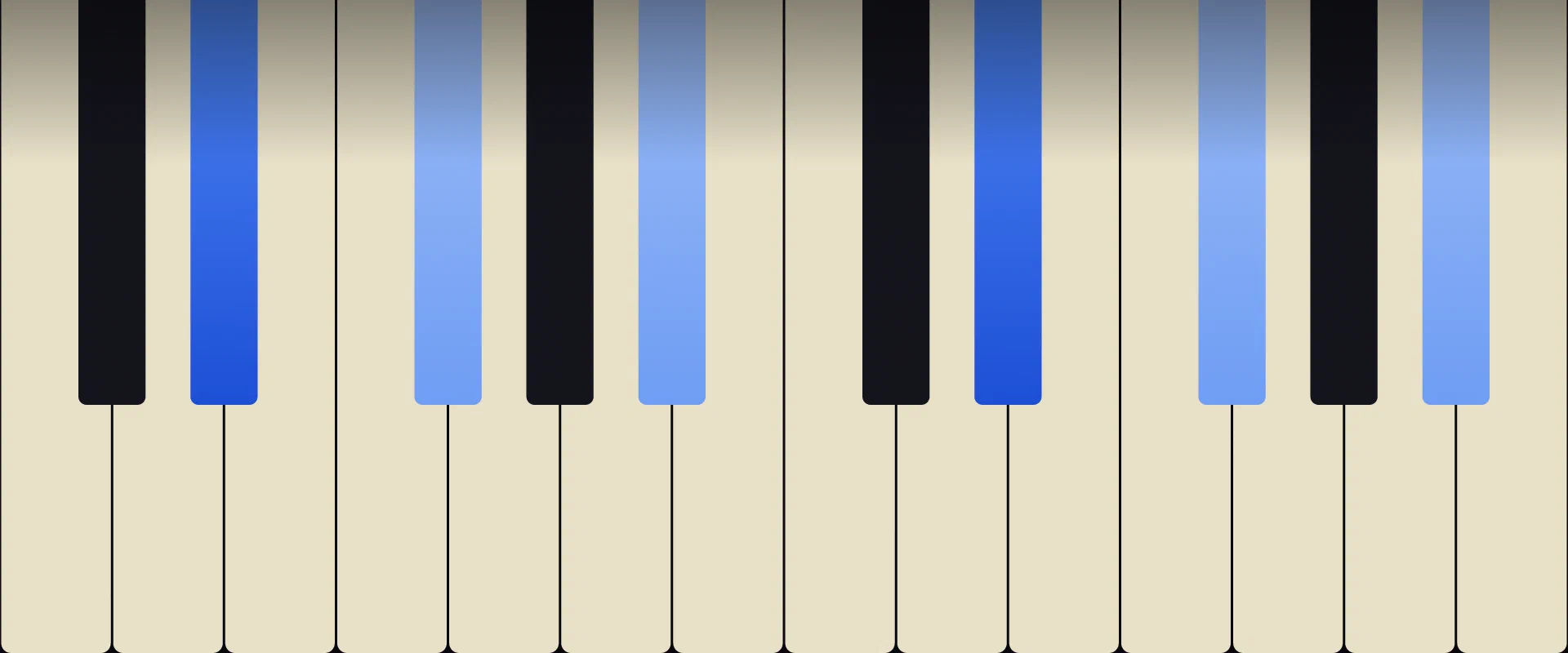
Sit at a piano, play E♭ minor, and your hand never touches a white key. Of the twelve minor triads this is the only one whose three notes are all black: E♭, G♭ and B♭. The key that grows out of the chord carries six flats, and orchestral string players quietly dread it, because not one of their open strings belongs to it. Chopin wrote a prelude, a polonaise and an étude here anyway, and a good number of rock guitarists have played the chord for years without ever calling it by name.
Try It: E♭m in the Chord Finder
The Notes of E♭m
The chord contains three notes: E♭, G♭ and B♭.
| Degree | Note | Interval from root | Semitones |
|---|---|---|---|
| 1 | E♭ | Root | 0 |
| ♭3 | G♭ | Minor 3rd | 3 |
| 5 | B♭ | Perfect 5th | 7 |
The symbol is E♭m. You will also meet E♭min and, in older piano editions, E♭ with a small dash after it.
How E♭m Is Built
E♭ major is E♭, G and B♭. Lower the middle note one semitone to G♭ and the chord turns minor: a minor third at the bottom, a major third above it, the reverse of the major triad’s stacking order.
That single semitone is unusually expensive on paper. E♭ major needs three flats in the key signature, E♭ minor needs six, so moving between the parallel keys means adding A♭, D♭ and G♭ all at once. Most composers mark that shift with a fresh key signature rather than a run of accidentals, which is a lot to read at speed.
E♭m on the Piano
Every note is a black key, which changes the mechanics of the shape more than most players expect. E♭ is the right hand key of the group of two. G♭ is the left hand key of the group of three, sitting directly next door with only the white F showing between them at the front. Skip past A♭ and you land on B♭, the right hand key of the group of three.
Because all three keys are raised by the same amount, the hand stays perfectly level. There is no tilt, no reaching forward with one finger while the others sit back, and no white key to squeeze a thumb into. Triads with a single black note are the ones that twist the wrist. This one does not, and beginners who assume six flats means six times the difficulty usually find the opposite.
Right hand fingering is 1 on E♭, 2 on G♭, 4 on B♭, which keeps the hand compact and deep in the keyboard. Left hand mirrors it: 5, 3, 1. Some teachers prefer 1, 2, 5 in the right hand for small hands, and either works, because a triad is struck rather than passed through.
The real cost is depth and width. The whole hand has to sit further back towards the fallboard, and the thumb, the shortest and least accurate finger, travels furthest to get there. Black keys are also narrower, so a loud chord played from the fingers alone tends to slide off the edge of E♭. Drop the weight from the arm and land on the middle of each key instead.
Chopin started new pupils on B major rather than C major, on the grounds that long fingers fall naturally onto raised keys. E♭ minor is that argument carried to its conclusion.
E♭m on the Guitar
There is no open E♭m, and there is no near miss either. Both barres are honest work.
The Am shape at the 6th fret, x 6 8 8 7 6, is the one to reach for first. Its root sits on the 5th string, the position falls in the comfortable middle of the neck, and the string tension there is far kinder than anything near the nut. The Em shape at the 11th fret, 11 13 13 11 11 11, gives a deeper root but pushes the hand up to where the frets crowd together and, on an acoustic with a 14 fret neck joint, the body starts fighting your thumb.
The cheapest E♭m on the instrument is neither of those. Take the open Dm shape and move it one fret up: x x 1 3 4 2. Four notes, no barre, first position, and it sits high enough in the register to cut through a band without needing the bottom strings at all.
Then there is the tuning. A large slice of blues and rock is played in E♭ standard, every string lowered a semitone, a habit that runs from Jimi Hendrix and Stevie Ray Vaughan through decades of bands who wanted slacker strings and a singer friendly pitch. On those guitars the open Em shape, 0 2 2 0 0 0, sounds E♭m. The player thinks Em, the chart says E♭m, and the six flats that terrify a pianist cost the guitarist nothing at all. If you are transcribing from a record and the chords come out a semitone flat of everything that sounds playable, this is almost always why.
Inversions
| Inversion | Notes | Lowest note |
|---|---|---|
| Root position | E♭ G♭ B♭ | E♭ |
| 1st inversion | G♭ B♭ E♭ | G♭ |
| 2nd inversion | B♭ E♭ G♭ | B♭ |
First inversion puts G♭ at the bottom, the voicing to use when the bass walks down A♭, G♭, F without the root ever moving. Second inversion keeps B♭ underneath, and since B♭ is also the root of the dominant it lets you sit on one bass note through a whole cadence.
Voicings
Spread the chord to give it weight: E♭ low in the left hand, then B♭ and G♭ above it in the right, so the minor third lands on top and the outer voices open to a tenth. Kept close and low, G♭ below middle C turns the chord into a growl, which is useful once and tiresome twice.
Orchestrally this key needs help. A violin section playing in E♭ minor has no open string to ring sympathetically, so the sound arrives dry and covered compared with the same chord in E minor. Composers compensate by spacing the voices wider and handing the third to a wind instrument. On guitar the three note fragment x 6 8 8 x x does the opposite job: strip the chord back and let the singer occupy the space.
Which Keys Contain E♭m
- i of E♭ natural minor
- i of E♭ harmonic minor
- ii of D♭ major
- iv of B♭ natural minor
- vi of F♯ major
- iii of B major
The last two are the same chord under a different name. In sharp keys the notes get written D♯, F♯ and A♯, and the symbol on the page becomes D♯m, because a key built on F♯ has no business carrying flats. The sound is identical.
Where E♭m Shows Up
i, VI, VII: E♭m, C♭, D♭. The standard minor loop, and a good demonstration of how far into the flats this key reaches. The VI chord is spelled C♭ major, which is B major by any other name, so guitar charts almost always print B and let the theory look after itself.
i, iv, V7: E♭m, A♭m, B♭7. The harmonic minor cadence. Note that the dominant is a plain B♭7 with a D natural in it, the one note in the neighbourhood that is not flattened, and that D pulling up to E♭ is what makes the resolution bite.
ii7, V7, Imaj7: E♭m7, A♭7, D♭maj7. Here the chord is not home but the approach: the ii of D♭ major, which is a favourite ballad key for horn players and one of the standard keys for “Body and Soul”. Jazz pianists meet E♭m far more often in this role than as a tonic.
i, VI, iv, V7: B♭m, G♭, E♭m, F7. As the iv of B♭ minor, the chord is a step of the descent rather than the destination, and it is worth hearing the difference. The same three notes feel settled in one context and restless in the other.
The repertoire treats this as a key of the piano, where six flats cost nothing, rather than of the orchestra, where they cost a great deal. Chopin’s Prelude Op. 28 No. 14 and his Polonaise Op. 26 No. 2 both live here, as does Rachmaninoff’s Prelude Op. 23 No. 9. Screen composers now reach for it freely, since a sampled orchestra inside a sequencer does not care how many flats sit in the key signature.
Related Chords
- E♭ Major Chord
- B♭ Major Chord
- B Major Chord
- Guitar Chord Shapes: The CAGED System
- Chord Progressions Every Musician Should Know
Learn More
Practice Chords
Drill chord recognition with a metronome, MIDI support, and score tracking.
Start Practicing