In This Is Spinal Tap, Nigel Tufnel sits at a piano and announces that D minor is the saddest of all keys. The line has outlived the film and deserves about ten seconds of serious attention. There is nothing in D, F and A that grieves harder than any other minor triad, and equal temperament flattened those differences out of the instruments two centuries ago.
What is true is that you meet this chord more than almost any other minor triad, for reasons of arithmetic rather than mood. Dm is the ii chord of C major, the key every beginner starts in, and the relative minor of F. On guitar it is one of only three minor triads with an open form that needs no barre, alongside Em and Am. Between the piano’s default key and the guitar’s cheapest shapes, this chord reaches nearly every player inside their first month.
Try It: Dm in the Chord Finder
The Notes of Dm
D minor is three notes: D, F and A.
| Degree | Note | Interval from Root | Semitones |
|---|---|---|---|
| 1 (Root) | D | Perfect unison | 0 |
| ♭3 | F | Minor 3rd | 3 |
| 5 | A | Perfect 5th | 7 |
Written as a symbol it is Dm, occasionally D min. Not one of the three notes carries an accidental, which is why this is the minor chord that sits inside the key of C major, and why it arrives in front of beginners with no key signature attached to it.
How Dm Is Built
Take D major, which is D, F♯ and A, and lower the F♯ a semitone to F. Nothing else moves. The outer fifth from D to A is untouched, so the chord keeps its weight and changes its face.
Stacked in thirds it reads D up to F, a minor third, then F up to A, a major third. The small interval underneath is what makes a triad minor. Dm also shares F and A with F major. Slide a D in beneath an F chord and the centre of gravity drops a third, which is what the relative major and minor relationship amounts to in the hand.
Dm on the Piano
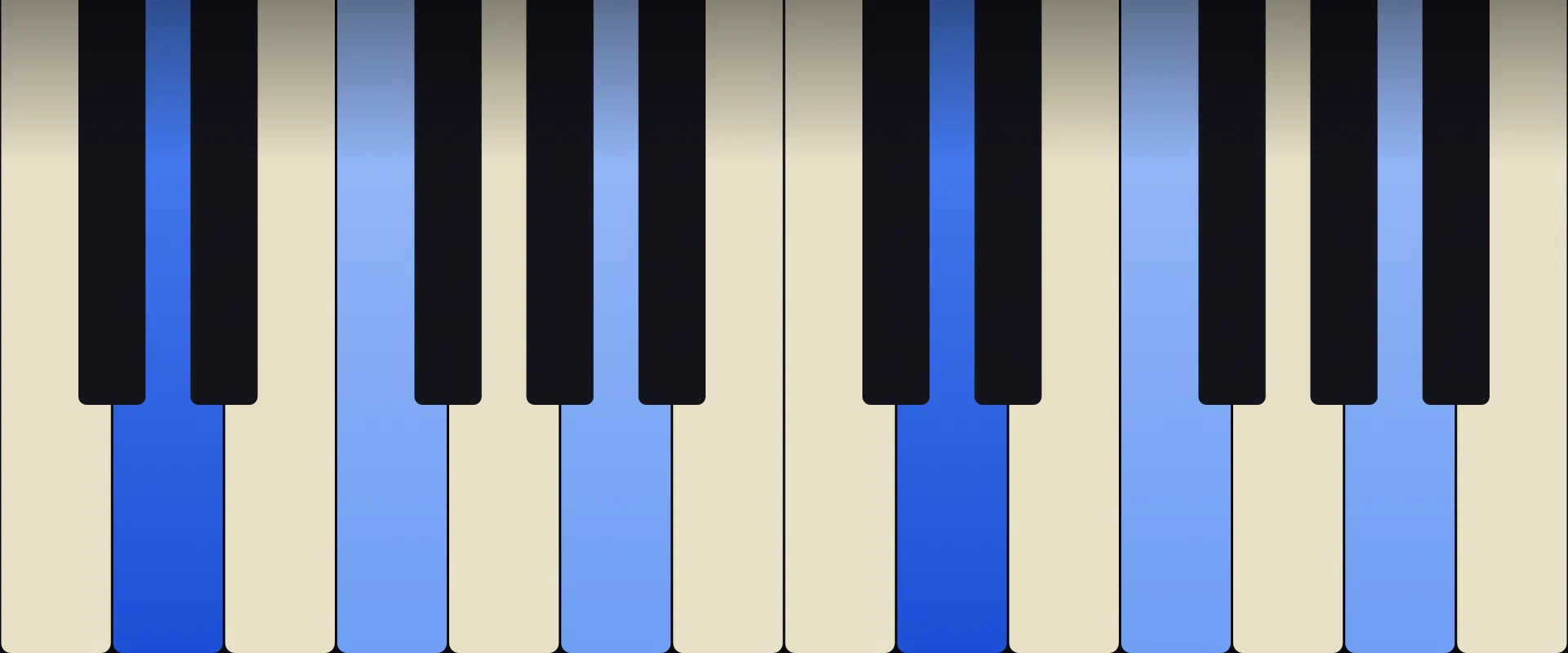
Three white keys, no black key, and the hand lands in the most legible position on the keyboard. The thumb takes D in the notch between the two black keys of the group of two, a landmark you cannot get wrong in the dark. The middle finger takes F, immediately left of the group of three. The little finger takes A, in the gap between the second and third black keys of that group. Right hand 1, 3, 5. Left hand 5, 3, 1.
Because no finger has to travel back between the black keys, the hand lies flat and forward, and that is the trap. A flat hand collapses at the knuckles and the notes come out uneven, F usually loudest. Keep the arch that D major forces on you and use it here, where nothing demands it.
D is also the mirror axis of the black key pattern, two behind it and three ahead, which is why the note feels like the middle of the instrument to most pianists. All three inversions of this chord stay on white keys, so the positions can be drilled as pure hand geometry with nothing to memorise about accidentals.
Dm on the Guitar
The open form is x x 0 2 3 1, and those two crosses cost you the bottom of the guitar. Four strings, and the lowest note is the open 4th string D. Em and Am anchor themselves on the two thickest strings; this one does not, so strum all three in a row and Dm sounds like it has taken a step back.
Low to high, the shape gives D, A, D and F. The minor third sits on top, on the 1st string at the 1st fret, which is the hardest note in the grip. The string is under most tension there and least forgiving of a lazy index finger, and a buzzing F on the top string is one of the commonest beginner faults on the instrument. Press just behind the fret wire.
The rest is a compact triangle on the top three strings: index on the 1st string at the 1st fret, middle on the 3rd at the 2nd, ring on the 2nd at the 3rd. Both suspensions grow out of it. Lift the index for x x 0 2 3 0, Dsus2. Add the little finger at the 3rd fret of the 1st string for x x 0 2 3 3, Dsus4. One finger in either direction, which is why so many songs sit on this shape and fidget.
For a real bass note, tune the 6th string down to D and play 0 0 0 2 3 1. Up the neck, the Am shape barred at the 5th fret gives x 5 7 7 6 5, where the frets are still wide and the barre is genuinely easy. The Em shape lands at the 10th fret, six strings of D minor, but the frets there are cramped enough that the ring and little fingers fight for room.
Inversions
| Inversion | Bass Note | Notes | Symbol |
|---|---|---|---|
| Root position | D | D, F, A | Dm |
| 1st inversion | F | F, A, D | Dm/F |
| 2nd inversion | A | A, D, F | Dm/A |
Dm/F is more than an inversion. F, A and D is an F6 chord with the fifth left out, so arrangers reach for it when they want the softness of F major without its finality. On guitar it is x x 3 2 3 1. Dm/A is free: let the open 5th string ring and play x 0 0 2 3 1.
Voicings
Guitar, open (x x 0 2 3 1). Bright, thin, the default. Minor third on top.
Guitar, drop D (0 0 0 2 3 1). Root two octaves down, and the chord has a floor.
Guitar, Am shape at fret 5 (x 5 7 7 6 5). Movable, controllable, easy to palm mute.
Piano, close (D, F and A in one hand). Clean under a vocal, muddy below middle C.
Piano, spread (left hand D and A, right hand F and D). The fifth opens into the bass and the third stays where it reads clearly.
Which Keys Contain Dm
Dm is a diatonic chord in six common keys:
- i of D natural minor
- ii of C major
- vi of F major
- iii of B♭ major
- iv of A natural minor
- v of G natural minor
The first three carry most of the traffic, and the ii of C major carries more than any of them.
Where Dm Shows Up
ii, V, I in C major: Dm, G, C. Extend it to Dm7, G7, Cmaj7 and you have the first thing every jazz student is made to play, in the key they are made to play it in. The F of this chord passes to the G7 as its seventh and then resolves to E. Hearing that one note move is most of what the exercise teaches.
i, VII, VI, V in D minor: Dm, C, B♭, A. The descending minor loop, and the reason the verse of Sultans of Swing sounds the way it does. Note the A rather than Am: raising the third to C♯ turns the last chord into a dominant that pulls back to Dm, which is what harmonic minor exists to provide.
I, vi, IV, V in F major: F, Dm, B♭, C. Dm as the shadow of the tonic, one step down and one shade darker. Fifties ballads ran on this.
For guitarists the key of D minor is lopsided. The tonic is free and the dominant A is easy, but the iv chord, Gm, needs a barre at the 3rd fret, so writers here route around it: B♭ and C instead, or a borrowed bright G major, or a capo. On bowed strings the picture inverts. A violin’s open D and A both belong to Dm, exactly as they do to D major, so the chord rings sympathetically without being asked. That resonance is why Bach put the Chaconne in D minor and Mozart his Requiem.
Related Chords
- D Major Chord, the parallel major, one semitone away.
- F Major Chord, the relative major, two notes shared.
- Suspended Chords: Sus2, Sus4 and Tension for Dsus2 and Dsus4, either side of the open shape.
- Seventh Chords: The Complete Guide for Dm7.
- The D Natural Minor Scale, where this chord is the tonic.
Learn More
Practice Chords
Drill chord recognition with a metronome, MIDI support, and score tracking.
Start Practicing