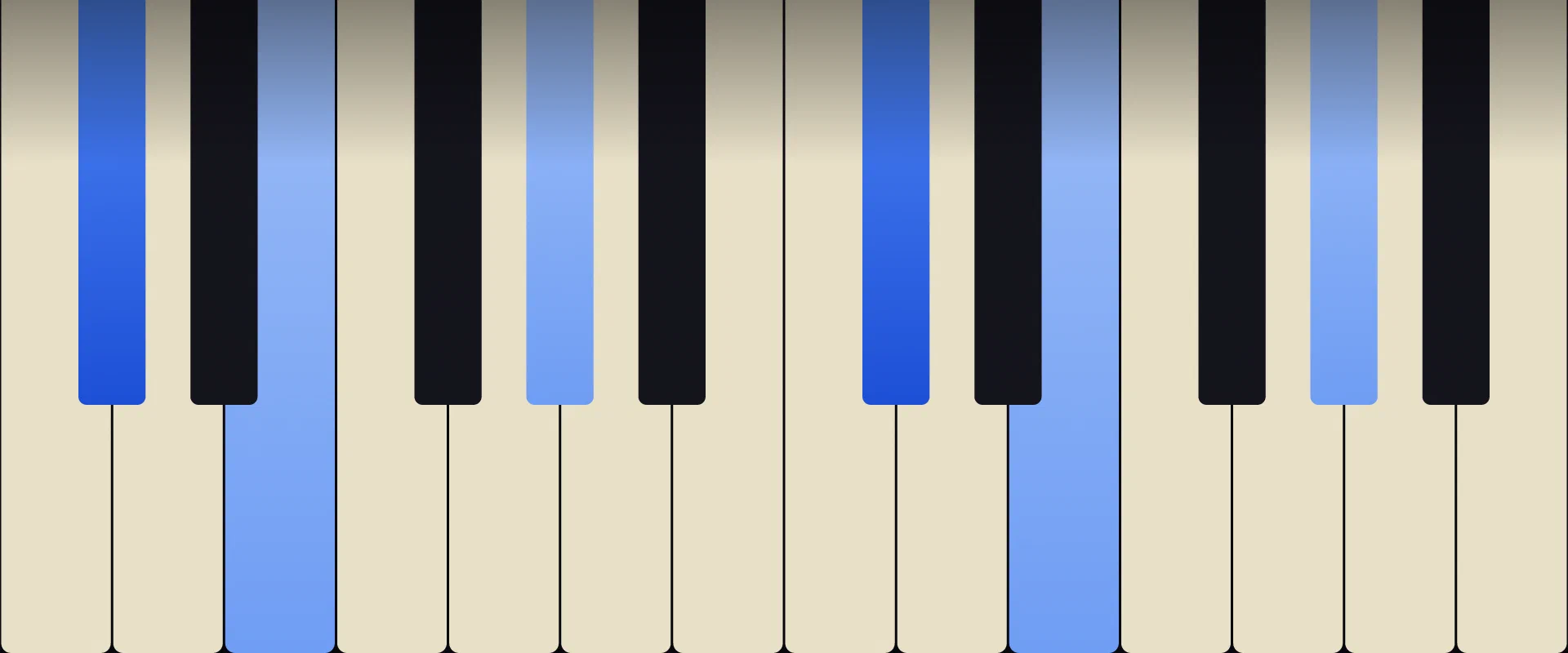
Four sharps, and no way out of them. C♯ major has an escape route, D♭ major, which spells the same pitches with five flats and no strange letter names. C♯ minor has no such option: respelled as D♭ minor it would need eight flats, one of them doubled, so the sharps stand. That is why the minor version is a working key with two centuries of repertoire behind it while the major version stays a curiosity, and why C♯, E and G♯ appear in far more printed music than C♯, E♯ and G♯ ever will.
Try It: C♯m in the Chord Finder
The Notes of C♯m
| Degree | Note | Interval from root | Semitones |
|---|---|---|---|
| 1 | C♯ | Root | 0 |
| ♭3 | E | Minor 3rd | 3 |
| 5 | G♯ | Perfect 5th | 7 |
The third is the interesting one. It is plain E, no accidental, exactly the letter a reader would guess. Sharpen it and the chord turns major, but that sharpened third has to be called E♯ and is played on the white key F, which is the reading trap that makes C♯ major awkward. Nothing here needs explaining away. Every note is spelled the way it sounds.
How C♯m Is Built
Start from C♯ major and lower the middle note by a semitone. The letter cannot change, because a third above any kind of C is always some kind of E, so E♯ becomes E natural and the distance from the root shrinks from four semitones to three. The outer interval is untouched: C♯ up to G♯ is still a perfect 5th, and that perfect 5th is what keeps the chord standing still. Flatten it too and you get C♯dim, which does not.
Written as a key, C♯ minor carries F♯, C♯, G♯ and D♯, the same four sharps as E major. The two are relatives, and on a chart in E major this triad is simply the vi. One more thing is worth knowing early: the tonic triad is identical in all three minor scales here, because natural, harmonic and melodic minor differ only at the 6th and 7th degrees. C♯, E and G♯ survive every version, so the chord you learn now serves all of them.
C♯m on the Piano
Black, white, black. Thumb and little finger take C♯ and G♯, the middle finger drops between them onto E, and because there is no black key between E and F the middle finger can meet E well back on the key, level with the two black ones. The hand stays flat, the wrist stays still, nothing has to reach forward and back. Right hand root position is 1, 3, 5. Left hand is the mirror: 5, 3, 1.
That shape pays a dividend across the whole key. F♯m (F♯, A, C♯) and G♯m (G♯, B, D♯) share the identical black, white, black profile, and those two chords are the iv and the v of C♯ minor. The three principal minor triads therefore sit under one hand shape, so a i, iv, v can be moved in blocks with no refingering at all. Not every key is that tidy. In B minor the same three chords demand three different profiles, and beginners who find this key intimidating on paper often discover their hands prefer it.
C♯m on the Guitar
There is no open C♯m. All six strings are tuned to naturals, so nothing rings unfretted into this chord. The standard answer is the A minor shape barred at the 4th fret with the root on the 5th string: x 4 6 6 5 4, index laid flat across fret 4, then the ring, little and middle fingers on frets 6, 6 and 5 of the D, G and B strings. Down at the 4th fret the strings are still stiff, but the grip is friendlier than the major version at the same position, which needs a second finger flattened across three strings on top of the barre.
Higher up, the E minor shape barred at the 9th fret gives all six strings and a low root. The frets are close together there, which suits small hands, though the voicing thins out and loses weight.
Players dodge the barre constantly, and this root offers three ways to do it. A capo at the 4th fret turns an open Am shape into C♯m. Tuning every string down a semitone, the E♭ standard that a great deal of rock is recorded in, makes an open Dm shape sound C♯ minor. Drop the sixth string a tone further and C♯ becomes an open string, so one finger produces a power chord on the root. That last tuning is the reason so much modern metal lives here: the key sits a comfortable semitone below D, and nobody involved has to count to four sharps.
Inversions
| Inversion | Notes | Lowest note |
|---|---|---|
| Root position | C♯ E G♯ | C♯ |
| 1st inversion | E G♯ C♯ | E |
| 2nd inversion | G♯ C♯ E | G♯ |
First inversion is how this chord appears when a bass line is walking through the key of E major, written C♯m/E and slotting between E and F♯m without the bass ever leaving stepwise motion. Second inversion, G♯ underneath, is the cadential shape: it leans towards the dominant and resolves back to root position. Guitarists get the inversions almost by accident, since the barred A shape already stacks G♯ on top and the top three strings alone give a first inversion.
Voicings
Two hands. Left hand takes the bare fifth, C♯ and G♯; right hand takes E, G♯ and C♯ above it. Both outer notes being black keys means the left hand can find that fifth without looking, which matters more than it sounds when the chord is a repeated accompaniment figure for eighty bars.
Add a seventh and two familiar chords fall out. C♯m7 adds B, and those four notes are also E6 with a different note underneath, so the two are interchangeable in pop comping. Raise that seventh instead and you get C♯m(maj7), topped by B♯, the leading note of C♯ harmonic minor and an accidental that lands on the white key C. That chord is the second bar of countless minor key ballads, on its way down to C♯m7.
On guitar, release the barre and keep frets 6, 5 and 4 on the G, B and top E strings. Three notes, no thumb pressure, and it cuts through a band better than the full six string version.
Which Keys Contain C♯m
- vi of E major
- iii of A major
- ii of B major
- i of C♯ natural minor
- v of F♯ natural minor
- iv of G♯ natural minor
The first three entries explain this chord’s popularity better than any theory does. E, A and B are the keys the guitar is built for, and this triad is the vi, the iii and the ii of them. Whichever of the three a band settles in, C♯m is already waiting.
Where C♯m Shows Up
| Progression | Chords | Turns up in |
|---|---|---|
| i VI III VII in C♯ minor | C♯m, A, E, B | Rock, metal, EDM loops |
| I V vi IV in E major | E, B, C♯m, A | The standard pop loop |
| ii V I in B major | C♯m7, F♯7, B | Jazz standards in sharp keys |
| i iv V i in C♯ minor | C♯m, F♯m, G♯, C♯m | Classical cadences, film cues |
The first two rows use the same four chords and differ only in where the gravity sits. Both are guitar shaped: the three chords surrounding this one are open forms, so the whole loop contains a single barre. Row four is the harmonic minor version, where the dominant G♯ needs B♯ to become major, and it is the sound of a piece closing properly rather than looping.
Piano gives the chord its most famous outing. The first movement of Beethoven’s Sonata Op. 27 No. 2, the Moonlight, is a stream of right hand triplets, and the first of them is G♯, C♯, E: this chord in second inversion, repeated for bars on end. Rachmaninoff’s Prelude Op. 3 No. 2 sits in the same key, as does a good deal of the nineteenth century’s stormier writing, which chose C♯ minor precisely because no alternative spelling was available.
Singers arrive here from both directions. Drop a song in D minor by a semitone, or lift one from C minor, and this is where it lands, which is a common fix when a chorus sits just above a comfortable range.
Related Chords
- C♯ Major Chord, the same root with E♯ in place of E, and the spelling problem that comes with it
- Suspended Chords: Sus2, Sus4 and Tension for C♯sus2 and C♯sus4, which remove the third and the major or minor question with it
- Seventh Chords: The Complete Guide for C♯m7 and C♯m(maj7)
- Chord Inversions and Voice Leading
- Guitar Chord Shapes: The CAGED System for moving the A and E minor shapes anywhere
Learn More
- Diatonic Chords: A Beginner’s Guide
- C♯ Natural Minor Scale, the key this chord anchors
- C♯ Minor Pentatonic Scale for soloing over it
- The Circle of Fifths Explained
- Extended Chords and Jazz Harmony
Practice Chords
Drill chord recognition with a metronome, MIDI support, and score tracking.
Start Practicing