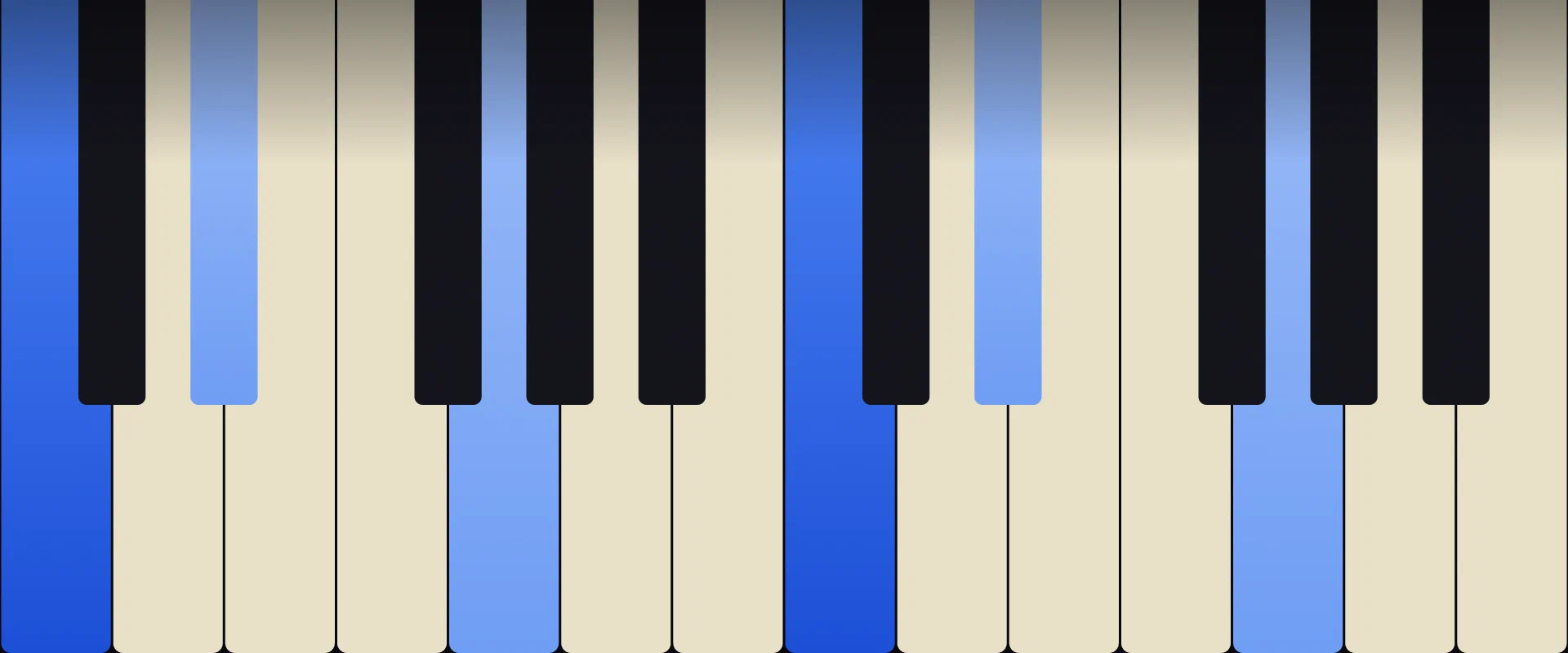
C minor is the relative minor of E♭ major and, for most pianists, the first minor chord that refuses to fit on the white keys. One note is responsible: E♭, the right hand key of the pair of black keys. That single key is where the textbook line about minor being major with a lowered 3rd stops being an abstraction and becomes something the hand has to do. Guitarists meet the chord from the opposite side. There is no open form for this root at all, so C minor arrives already barred at the 3rd fret, which is a large part of why a band that starts writing in C minor so often finishes the session in A minor or E minor. Keyboard players and orchestral writers have no such reason to move, and they have kept C minor busy for three centuries.
Try It: Cm in the Chord Finder
Set the root to C and switch to minor. Two notes light up on white keys and one lands on black.
The Notes of Cm
| Degree | Note | Interval from root | Semitones |
|---|---|---|---|
| 1 (root) | C | Perfect unison | 0 |
| ♭3 | E♭ | Minor 3rd | 3 |
| 5 | G | Perfect 5th | 7 |
Written out: C, E♭, G. The third is E♭ and never D♯, even though the two are the same key. A triad uses every other letter, C then E then G, so the middle note has to keep the letter E and take a flat with it. Spell it D♯ and the chord has no E at all, which makes the interval look like a 2nd on paper.
How Cm Is Built
Play C major, C, E and G, then move the E down one semitone to E♭. Nothing else changes. The outer frame, C up to G, is a perfect 5th in both chords, which is why the two feel like the same chord in two moods rather than two different chords. Inside that frame the order of the thirds flips: three semitones then four, instead of four then three.
Keep going from there and the chord grows. B♭ on top gives Cm7, D above that gives Cm9, and A instead of B♭ gives Cm6. Raise the seventh to B natural and you get Cm(maj7), the chord that sits at the bottom of C harmonic minor and supplies the leading note that C natural minor lacks.
Cm on the Piano
The root and the third share one landmark. C is the white key immediately to the left of the two black key group, and E♭ is the right hand key of that same group, so once your fingers have found the pair the chord is already half located. Nothing has to be counted from the edge of the keyboard.
Right hand: thumb on C, third finger on E♭, fifth finger on G. Left hand: 5, 3, 1 reading upwards. The third finger is the only one that travels in towards the fallboard, so the hand ends up slightly tilted, with the thumb and little finger out on the wide part of the white keys and the middle of the hand pushed forward. Keep the wrist level rather than letting it drop on the thumb side, because a dipped wrist makes the third finger approach E♭ at an angle and it slides off the narrow key.
The best drill this chord offers is the switch itself. Hold C major, then move the third finger back onto E♭ and forward again, over and over, without touching the other two fingers. The whole physical difference between C major and C minor is one finger and roughly two centimetres of travel, and hearing that gap open and close is worth more than reading about it.
Cm on the Guitar
No open form exists for this root, and the reason is worth stating plainly: of the six open strings, only the 3rd string G is in the chord. The low E and A, the D, the B and the top E are all outside it. On a guitar that is a real loss, because open strings are where the instrument’s ring and sustain come from. E minor and A minor sound enormous for free. C minor has to be held down, every note of it.
The working shape is the A shape barred at the 3rd fret, x 3 5 5 4 3. The barre is comfortable there, clear of the stiff first fret, and it puts the root on the 5th string. For a heavier version, the E shape barred at the 8th fret, 8 10 10 8 8 8, gives all six strings with C in the bass, which is what rock players reach for when the arrangement has to stay in C minor.
The third option is the one most acoustic records actually used. Clamp a capo at the 3rd fret, play ordinary A minor shapes, and the result sounds as C minor with the open strings back in play above the capo. If a fingerpicked part in C minor rings in a way a barre chord never does, that is usually what happened.
Inversions
| Inversion | Notes | Bass | Symbol |
|---|---|---|---|
| Root position | C E♭ G | C | Cm |
| 1st inversion | E♭ G C | E♭ | Cm/E♭ |
| 2nd inversion | G C E♭ | G | Cm/G |
Cm/E♭ is more than a rearrangement. It puts the tonic of the relative major in the bass, and adding B♭ underneath turns the same pitches into E♭6, which is why Cm7 and E♭6 are note for note identical. Cm/G is the pedal option: hold G in the bass and Cm and G7 can trade places without the bass moving, the standard way of tightening a i to V in C minor. For the mechanics, see Chord Inversions and Voice Leading.
Voicings
Three notes in one hand is the thin version. Put a low C alone in the left hand and E♭, G and C in the right, and the gap in the middle lets the chord breathe. Doubling C at the top rather than G keeps it firmly minor, because the E♭ then sits in the middle of the texture where it colours everything above it.
On guitar the shapes below all move as a block.
| Shape | Frets | Result |
|---|---|---|
| Cm | x 3 5 5 4 3 | A shape, 3rd fret barre |
| Cm | 8 10 10 8 8 8 | E shape, 8th fret barre |
| Cm7 | x 3 5 3 4 3 | Soul and jazz workhorse |
| Cm9 | x 3 1 3 3 3 | Lush, no barre needed |
| Cm6 | x 3 1 2 1 x | Adds A, points to F |
Which Keys Contain Cm
- i of C natural minor
- vi of E♭ major
- ii of B♭ major
- iii of A♭ major
- iv of G natural minor
- v of F natural minor
Where Cm Shows Up
| Progression | Chords | Context |
|---|---|---|
| i iv V (C minor) | Cm, Fm, G7 | Classical, ballads |
| i VI III VII (C minor) | Cm, A♭, E♭, B♭ | Film, metal, pop |
| ii V I (B♭ major) | Cm7, F7, B♭maj7 | Jazz standards |
| I vi IV V (E♭ major) | E♭, Cm, A♭, B♭ | Doo wop, soul |
The G7 in the first row is the giveaway that the key is minor and the chord on the fifth degree is not. That major dominant comes from C harmonic minor, which raises B♭ to B natural so the scale gets a leading note pushing up into C.
The third row explains why so many players know Cm7 before they know Cm. B♭ major is the home key of the brass and reed section: trumpet, tenor saxophone and clarinet are all pitched in B♭. A tenor player reading concert Cm7 sees D minor 7 on the page, one of the easiest chords on the instrument, so big band and soul charts settle into keys where Cm7 is the ii chord almost by default.
Strings pull the other way and land in the same place. Cello and viola both have open C and G strings, so the root and the fifth of this chord are available without a finger down, and the instrument resonates when C minor is the key. That is a sympathy the guitar cannot offer, and it is part of why the orchestral repertoire keeps returning here: Beethoven’s Fifth Symphony, his Pathétique sonata, Mozart’s K. 491 and Brahms’s First all live in C minor.
Producers arrive by a third route. A piano roll opens on C, and a writer who wants a minor sound without thinking about a key signature drops the third and is already in C minor. A great deal of trap, drill and soundtrack work sits there for no deeper reason than that.
Related Chords
- The C Major Chord, the same chord with E in place of E♭
- Seventh Chords: The Complete Guide for Cm7 and Cm(maj7)
- Extended Chords and Jazz Harmony for Cm9 and Cm11
- Suspended Chords: sus2 and sus4 for the chords that remove the third entirely
- Guitar Chord Shapes: The CAGED System for moving the barre shapes around
Learn More
Practice Chords
Drill chord recognition with a metronome, MIDI support, and score tracking.
Start Practicing