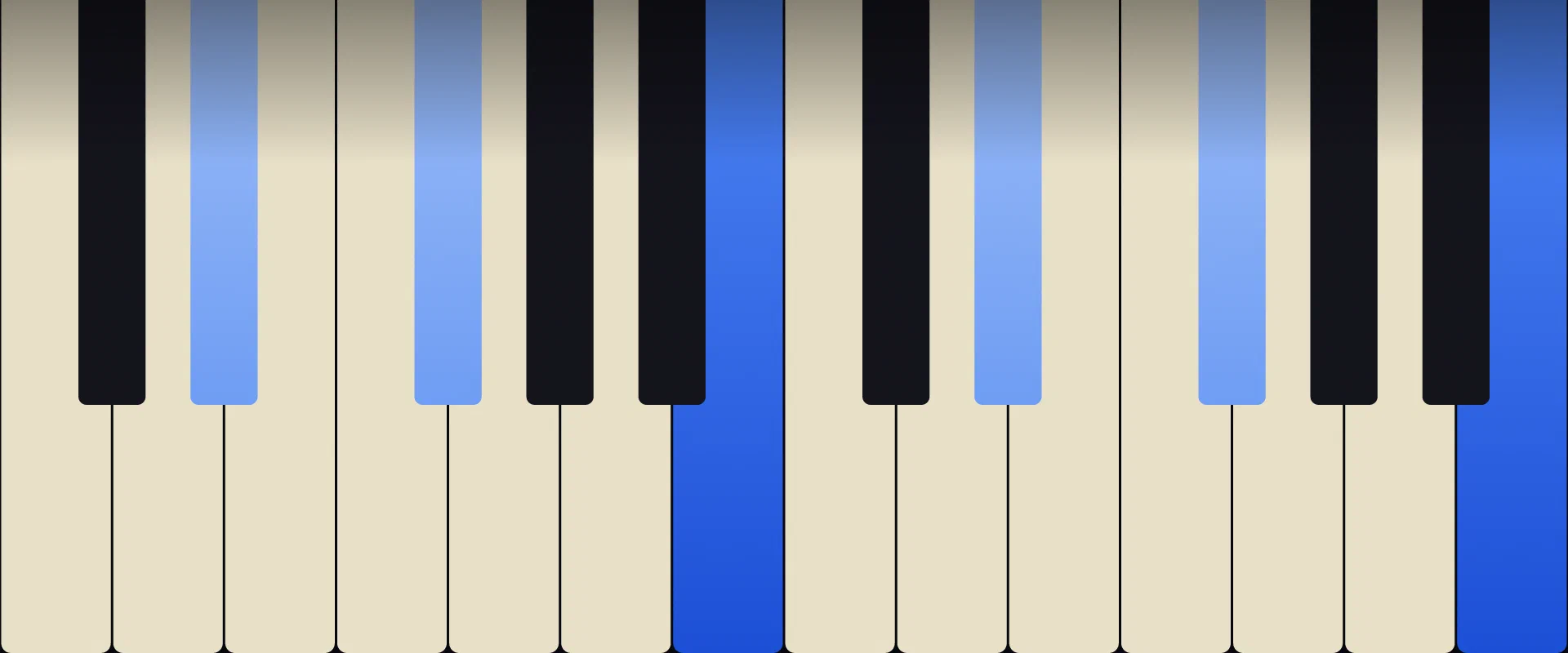
Hardly anybody writes songs in B major. Five sharps scares off most players, and the key signature turns up more often in analysis than on a lead sheet. The chord, though, is unavoidable. B is the V of E major, and E is the key the guitar was practically built around, so players who have never read a five sharp key signature in their lives still grab a B chord several times a night. Rare as a key, constant as a chord: that gap is the whole story here.
The bill arrives on the fretboard. B is one of the few roots with no open shape at all, so the instrument refuses to hand it over for free.
Try It: B in the Chord Finder
The Notes of B
| Degree | Note | Interval from Root | Semitones |
|---|---|---|---|
| 1 (Root) | B | Perfect unison | 0 |
| 3 | D♯ | Major 3rd | 4 |
| 5 | F♯ | Perfect 5th | 7 |
The middle note is the one people query. On a keyboard D♯ and E♭ are the same black key, and E♭ is the friendlier name, so why insist on D♯?
Because a triad is a stack of thirds, and a third skips exactly one letter. Count up from B: B, C, D. The third here has to be a form of D. B to D natural is three semitones, a minor third, so the D is sharpened to reach four. Spell it E♭ and the chord reads B, E, F, which looks like a fourth under a second rather than a plain major triad. The same logic fixes the top note: B to F natural is a diminished fifth, so F♯ it is.
How B Is Built
Start from B minor, B D F♯, and raise the middle note one semitone. That single move from D to D♯ is the entire difference between the two chords, and it comes back later as the note that brightens an E minor cadence.
Coming the other way, the B5 power chord is just B and F♯, blank in the middle. Dropping D♯ into that gap is what commits it to major.
There is a road not taken. The same pitches could be written C♭ major, C♭ E♭ G♭. Nobody does, because C♭ carries seven flats against B major’s five sharps, and C♭ survives only as a passing spelling inside deeply flat music.
B on the Piano
Two of the three notes are black keys, D♯ and F♯, with only the root on white. That ratio is why the shape feels better under the hand than its accidental count suggests: the hand sits forward, near the fallboard, instead of stranded flat on the whites. Chopin started pupils on B major rather than C major for exactly this reason: raised keys suit the longer fingers, and the terrain does half the work of shaping the hand.
For the root position triad the textbook right hand fingering is 1 on B, 3 on D♯, 5 on F♯. It works, but the shortest finger is being asked to stand on a raised key. Try 1, 2, 4 instead: keeping the weakest finger off the black key steadies the chord, and the stretch from B to F♯ loses nothing. In the left hand, 5, 3, 1 puts the thumb on F♯, fine here because it arrives from below and passes under nothing.
The inversions are where the layout starts charging rent. First inversion stacks the two black keys at the bottom and puts white B on top, so the thumb lands on D♯ and pushes the hand deep into the keyboard. Second inversion is worse: F♯ black, B white, D♯ black. The hand has to reach in, back out, and in again across three adjacent notes. Practise that one slowly, with the wrist level, or the middle note starts arriving late.
B on the Guitar
There is no open B major. The A shape barred at the 2nd fret is the working answer, written x24442: root B on the fifth string at fret 2, then F♯, B and D♯ across the middle strings at fret 4, and F♯ on the top string back at fret 2.
That fret 4 cluster is the problem. Three notes on three adjacent strings, all at the same fret, sitting directly behind a barre. Two ways to cover them, and both are uncomfortable. Flatten the second, third and fourth fingers into a single fret and they have to stand almost vertically, crowded into a space narrower than three fingertips. Or barre fret 4 with the ring finger alone, easier to reach but requiring enough arch to leave the first string ringing at fret 2 underneath. Most players never fully win that one and quietly mute the top string, playing x2444x.
Position makes it harder still. Fret 2 sits close to the nut, where the frets are widest and the tension highest, so the index barre needs more force than the same shape needs at fret 7. The E shape alternative, 799877 at the 7th fret, is an easier grip but sits far enough up the neck to change the voicing’s weight entirely.
Which is why so many guitarists learning songs in E never play B at all. They play x21202 instead, the open B7, which uses the open second string, needs no barre, and does the same dominant job. B may be the only major chord whose usual beginner substitute is a seventh chord.
Inversions
| Inversion | Notes | Bass Note |
|---|---|---|
| Root position | B D♯ F♯ | B |
| 1st inversion | D♯ F♯ B | D♯ |
| 2nd inversion | F♯ B D♯ | F♯ |
As slash chords these are B/D♯ and B/F♯. B/D♯ earns its keep in the key of E, slotting between E and C♯m so the bass walks by step instead of leaping a fifth.
Voicings
Split it across both hands and it opens up: a bare B and F♯ fifth low in the left, D♯ F♯ B in the right. The third then sits high, where it sounds clear, rather than clouding the bass.
On guitar the top three strings hold all three inversions in compact grips. Frets 4, 4 and 2 on G, B and high E give root position, the top half of the barre shape on its own. Move to 8, 7, 7 for first inversion and 11, 12, 11 for second. These are how you comp behind a singer in E without a full barre swallowing the arrangement.
Which Keys Contain B
- I of B major
- IV of F♯ major
- V of E major
- III of G♯ natural minor
- VI of E♭ natural minor
- VII of C♯ natural minor
Where B Shows Up
| Progression | Numerals | Chords |
|---|---|---|
| Rock and blues in E | I, IV, V | E, A, B |
| Cadence into E minor | i, iv, V | Em, Am, B |
| Pop loop in G♯ minor | i, VI, III, VII | G♯m, E, B, F♯ |
| The key itself | I, vi, IV, V | B, G♯m, E, F♯ |
The first line explains the chord’s whole career. E major suits the guitar because two strings are already tuned to E and the low one rings open under everything. Its I and IV, E and A, are open chords. Its V is not. The instrument’s most natural key contains exactly one chord it cannot play without a barre.
The second line brings back the D♯. E natural minor has a D natural, which makes its fifth chord Bm, and Bm resolves to Em with no pull at all. Sharpen that D and v becomes V, B major, with D♯ leaning hard on the E a semitone above. Countless minor key songs are otherwise diatonic and borrow this one note only at the cadence, to get the door to close.
Songs actually in the key of B tend to be vocal led, since the tonic sits well for a lot of singers. Guitarists reaching that key rarely do it the hard way: capo at fret 4 with G shapes, or fret 2 with A shapes, both land in B with open strings back in play.
Wind players are the ones who really pay. A trumpet in B♭ reading concert B major is reading C♯ major, seven sharps. An alto saxophone in E♭ would be reading G♯ major, which needs eight sharps including an F double sharp, so the part gets respelled as A♭ major and everyone agrees not to mention it. That is why B major essentially never appears in a big band chart while guitar bands treat it as routine. The same three notes, two reputations.
Related Chords
- Suspended Chords: Sus2, Sus4 and Tension
- Guitar Chord Shapes: The CAGED System
- Secondary Dominants and Borrowed Chords
- Chord Progressions Every Musician Should Know
Learn More
Practice Chords
Drill chord recognition with a metronome, MIDI support, and score tracking.
Start Practicing