Four instruments you are likely to meet in any rehearsal room are pitched in B♭: the trumpet, the clarinet, the tenor saxophone and the soprano saxophone. When any of them reads a written C, the note that comes out of the bell is a concert B♭. Their scales, their warm-ups and their most comfortable fingerings all sit on this chord. That one piece of instrument design is why jazz heads, big band charts, marching band books and brass repertoire pile up in B♭ and its neighbours, and why a guitarist handed a horn chart suddenly finds there is not an open string in sight.
Try It: B♭ in the Chord Finder
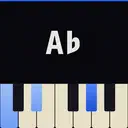
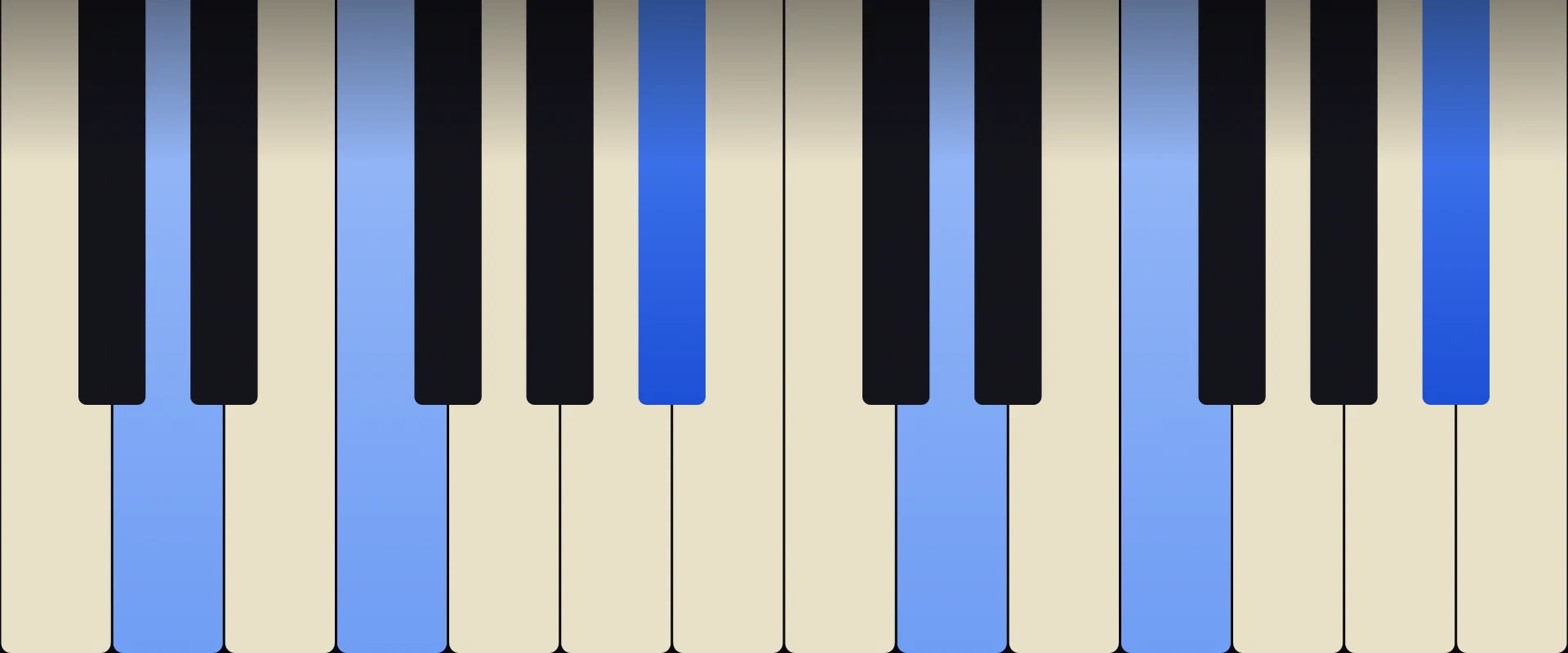
Set the root to B♭ and you will see one black key lit and two white ones, the only major triad shaped that way.
The Notes of B♭
B♭ major is a three note triad: B♭, D and F.
| Degree | Note | Interval from B♭ | Semitones |
|---|---|---|---|
| 1 (root) | B♭ | Perfect unison | 0 |
| 3 | D | Major 3rd | 4 |
| 5 | F | Perfect 5th | 7 |
The chord symbol is simply B♭. No suffix is needed, because a bare letter name always means the major triad.
How B♭ Is Built
Stack a major 3rd on B♭ and you reach D. Stack a minor 3rd on top of that and you reach F. The outer interval, B♭ up to F, is a perfect 5th.
Strip the D away and B♭5 remains, stable but silent about mood. Lower that D by a semitone to D♭ and you have B♭ minor, a chord whose home key carries five flats. The identity of B♭ major sits entirely in that D natural, the note a trumpet plays when it reads a written E.
B♭ on the Piano
Look at the twelve major triads on a keyboard and B♭ is the odd one out. It is the only major triad whose black key is the root and whose other two notes are both white. D major, A major and E major each have one black key, but in every case it is the 3rd sitting in the middle. B♭ puts the accidental at the bottom of the stack: black, white, white, left to right, and nothing else in the set reads that way.
That geometry decides how the hand sits. Play it right hand 1 on B♭, 3 on D, 5 on F. The thumb goes in among the black keys while the third and fifth fingers stay out on the white keys near the front edge, so the hand rests at a slight angle instead of square on. Most players find this more comfortable than an all white triad, because the thumb has something raised to aim at rather than a wide flat key it can slide around on.
Left hand takes 5 on B♭, 3 on D, 1 on F. Here the little finger is the one on the black key, and it needs to press further back than the thumb does. Keep the wrist level as it reaches in and the three notes will speak evenly.
Turn the chord over and the comfort disappears. In first inversion, D F B♭, the black key moves to the top under the right hand fifth finger, which now has to reach back between two white keys with the weakest finger on the hand. If that voicing gives you trouble, use 1 on D, 2 on F, 4 on B♭ instead and let the stronger fourth finger take the reach.
B♭ on the Guitar
B♭ has no open form. There is no arrangement of open strings and stopped notes that produces B♭, D and F without a barre or a partial, which puts it in a small group of roots that guitarists quietly avoid when choosing a key.
The textbook answer is the A shape barred at the 1st fret: index across five strings at fret 1, ring finger flattened over the D, G and B strings at fret 3. From the fifth string up that gives B♭, F, B♭, D, F. It is also the least pleasant barre on the instrument. Frets sit furthest apart at the 1st, so the stretch between the two shapes is at its longest, and the barre lands right beside the nut where the string is already anchored, so it buzzes unless you press hard. Most players give the position up.
Two escapes are standard. Move to the E shape barred at the 6th fret, the same chord with its root on the sixth string and a far friendlier barre. Or, as on most records, drop the barre altogether and play only the D, G and B strings at the 3rd fret: three fingers, three notes, F, B♭ and D, no thumb pressure at all. Funk and soul rhythm guitar lives on this partial, and it cuts through a horn section better than the full barre, because no doubled bass note fights the tuba or the bass guitar.
Inversions
| Inversion | Notes | Bass note | Symbol |
|---|---|---|---|
| Root position | B♭ D F | B♭ | B♭ |
| 1st inversion | D F B♭ | D | B♭/D |
| 2nd inversion | F B♭ D | F | B♭/F |
B♭/D earns its keep as a bass connector. Moving B♭ to B♭/D to E♭ walks the bass up by step from B♭ to D to E♭ while the upper voices barely move, which is far smoother than jumping down a fifth.
B♭/F is the voicing a guitarist plays whenever they grab that three string partial at the 3rd fret, so a great deal of recorded B♭ is second inversion without anyone thinking about it. In E♭ major, where B♭ is the dominant, the classical approach is the other way round: E♭/B♭ sitting over a B♭ bass before resolving to B♭ itself.
See Chord Inversions and Voice Leading for how these choices behave in a progression.
Voicings
Close position sounds compact, which suits comping behind a soloist. Open it out, B♭ low, F a fifth above, D on top, and it gains air. Spacing matters more here than in brighter keys, because so much B♭ writing sits in low brass, where a close triad turns to mud fast.
For piano in a jazz setting, leave the root to the bass and voice B♭ with D and F in the left hand, adding the 7th (A♭ for B♭7, A for B♭maj7) with the right. That is the practical starting point for the harmony described in Seventh Chords: The Complete Guide.
Which Keys Contain B♭
- I of B♭ major
- IV of F major
- V of E♭ major
- III of G natural minor
- VI of D natural minor
- VII of C natural minor
Where B♭ Shows Up
Rhythm changes are in B♭. The form built on “I Got Rhythm” is the second most played structure in jazz after the blues, and its A section opens with a I, vi, ii, V turnaround:
B♭ | Gm | Cm7 | F7
The twelve bar blues jam key is B♭ too, for the same reason: it is written as C for the trumpets and tenors, and as G for the alto and baritone saxophones, which are pitched in E♭. Every horn in the room gets a readable key signature. The turn into the tonic is the standard ii, V, I:
Cm7 | F7 | B♭maj7
Away from the horns, B♭ turns up most often as a borrowed brightness inside minor keys. In C minor it is the VII, and the descent
Cm | B♭ | A♭ | Gm
is the backbone of a great deal of rock and film cue writing. In D minor it is the VI, and
Dm | B♭ | F | C
is one of the most recorded four chord loops there is. Both of those are guitar progressions, which is exactly where the friction shows: the singer wants D minor, the loop wants B♭, and the guitarist is back at the 1st fret or reaching for a capo.
A trumpet part written in C is sounding your B♭ chord, so if a horn player calls out “C” and the rhythm section plays C major, everyone is a whole tone apart. See How to Transpose a Song to Any Key for the arithmetic.
Related Chords
- Suspended Chords: Sus2, Sus4, and the Art of Tension covers B♭sus4 and B♭sus2, both easy substitutions for the three string partial.
- Guitar Chord Shapes and the CAGED System explains why the A shape lands on the 1st fret for this root and where its other four positions are.
- The ii V I Progression in Jazz works through Cm7, F7, B♭maj7 in detail.
- Extended Chords and Jazz Harmony takes B♭ past the triad.
Learn More
Practice Chords
Drill chord recognition with a metronome, MIDI support, and score tracking.
Start Practicing