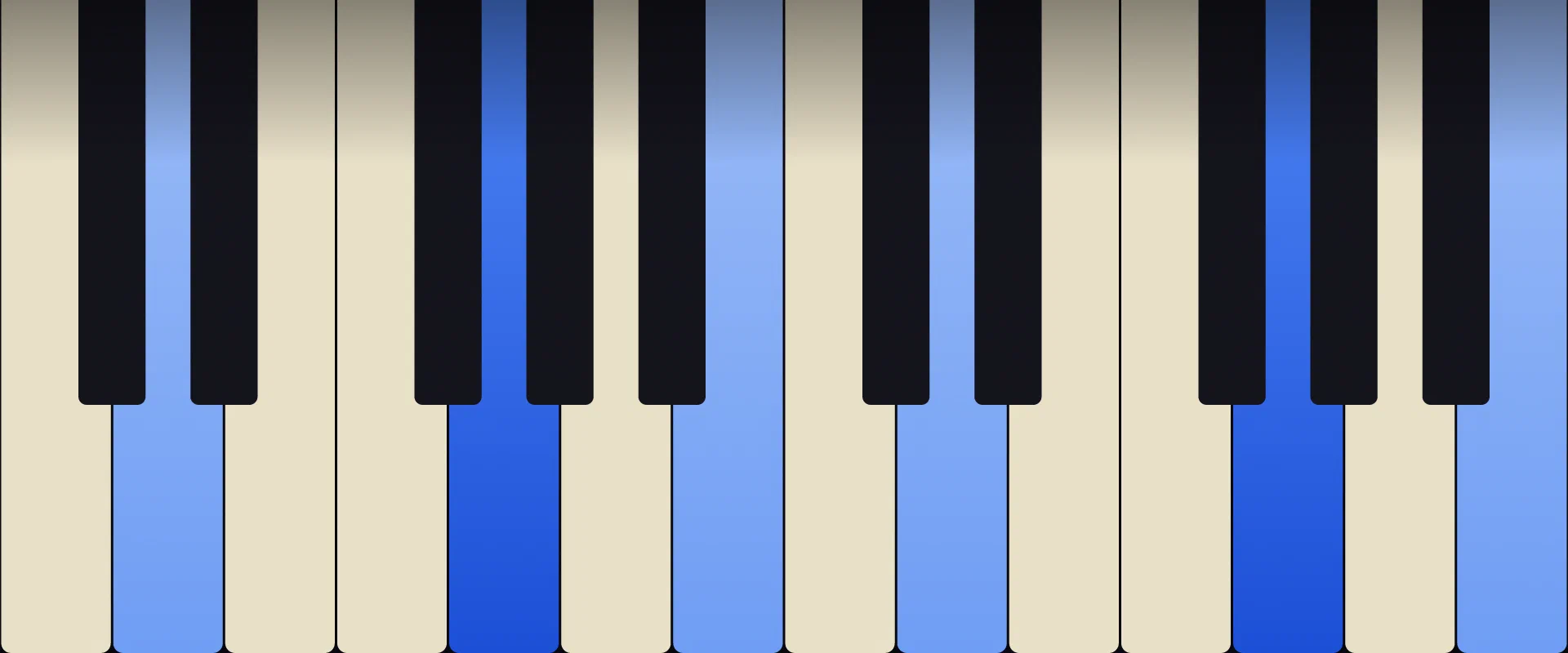
Tune a guitar to standard pitch and it is already holding a G major chord. The open D, G and B strings sound D, G and B, a second inversion G with nothing fretted at all. Press the 3rd fret of the bottom string and the 2nd fret of the A string and all six ring as G. No other major triad sits that close to the surface of the instrument, which is why G is to the guitar roughly what C is to the piano.
The three notes are G, B and D, all white keys. The key of G major has exactly one sharp, F♯, and the guitar’s open strings supply five of its seven degrees: E, A, D, G and B cover 6, 2, 5, 1 and 3. Only C and F♯ have to be fretted. That fact sits behind an enormous amount of folk, country, bluegrass and singer songwriter repertoire.
Try It: G in the Chord Finder
The Notes of G
| Degree | Note | Interval from Root | Semitones |
|---|---|---|---|
| 1 (Root) | G | Perfect unison | 0 |
| 3 | B | Major 3rd | 4 |
| 5 | D | Perfect 5th | 7 |
The chord symbol is bare, just G, with none of the enharmonic traps that catch players out in C♭ or E♯ territory.
How G Is Built
A major 3rd above G is B, four semitones up; a minor 3rd above B is D, three more. Four plus three builds every major triad, and here it lands entirely on the naturals.
The nearest simpler chord is G5, the bare power chord of G and D, which guitarists get almost for free: 3rd fret of the bottom string plus the open D string. B is the note that decides quality. Lower it to B♭ and you have G minor, which needs a flat and, on guitar, a barre. Add F natural instead (not F♯, despite the key signature) and you have G7, still all white keys and the first dominant seventh most pianists play.
G on the Piano
Only three major triads on the keyboard are made entirely of white keys: C, F and G. Easy to find, and slightly dangerous to learn on. With no black keys to reach over, beginners flatten the hand and let the wrist sink, then rebuild the whole position the moment an accidental arrives.
Finding G by touch is quick. It is the middle white key of the F, G, A, B group, in the notch between the first and second of the three black keys. The right hand takes 1 on G, 3 on B and 5 on D, the left mirrors it 5, 3, 1. Keep the knuckles domed even though nothing forces you to.
Register matters more than fingering. G B D played low, around G2, puts a major 3rd where the overtones collide and the chord turns to sludge. Leave G and D in the left hand and lift B an octave into the right, so the third sounds above middle C.
The most useful voice leading here comes from first inversion. Play B, D, G, then move B up to C and D up to E: you land on C major with the G held in common. That is the V to I cadence of C major with two fingers moving a step each.
G on the Guitar
The open form is 3 2 0 0 0 3, six strings, no muting, and it is the only common open major chord that uses every string without asking you to damp one. It also has two standard fingerings, and they are not interchangeable.
The traditional fingering puts the index on the 5th string, 2nd fret, the middle on the 6th string, 3rd fret, and the ring on the 1st string, 3rd fret. The little finger hovers unused. It feels natural first time and is what most self taught players settle into.
The better fingering shifts everything up one digit: middle on the 5th string, ring on the 6th string, little finger on the 1st string. The index is now free, and that is the whole point.
Watch the move to C, x 3 2 0 1 0. From the second fingering the ring finger drops from the 6th string to the 5th at the same 3rd fret, the middle from the 5th string to the 4th at the same 2nd fret, and the idle index lands on the 1st fret of the 2nd string: the hand keeps its shape and slides across one string. From the traditional fingering the index is already committed to the A string, so it must be pulled off and repositioned while the rest of the hand waits: at tempo the change stalls.
The same logic gives you a bass line. Lift the ring finger off the bottom string and mute it, and the middle finger is already sitting on B: x 2 0 0 0 3 is G/B, ready without a single reposition.
Then there is the four finger version, 3 2 0 0 3 3, which adds the 3rd fret of the 2nd string. Hold the top two strings down at the 3rd fret and move only the lower fingers, and you get Cadd9 at x 3 2 0 3 3 and Dsus4 at x x 0 2 3 3. Those two notes, G and D on the top strings, drone unchanged across I, IV and V. A great deal of acoustic pop is written in the key of G purely because that drone exists.
Away from the nut, G is an E shape barred at the 3rd fret. The strings are still under high tension that low, so the barre takes real grip, though it is kinder than F. An A shape barre at the 10th fret gives a thinner voicing.
Inversions
| Inversion | Notes | Bass | Symbol |
|---|---|---|---|
| Root position | G B D | G | G |
| 1st inversion | B D G | B | G/B |
| 2nd inversion | D G B | D | G/D |
G/B earns its keep as a passing chord: in the key of C it slots between C and Am so the bass walks C, B, A instead of jumping. G/D is the cadential six four of G major, held over a D bass before the dominant arrives. On guitar that second inversion needs no fingers at all: the open 4th, 3rd and 2nd strings already spell D, G, B.
Voicings
The two open guitar shapes differ for a structural reason. Standard 3 2 0 0 0 3 gives G, B, D, G, B, G: three roots, two thirds, a single fifth, dense and emphatically major. The four finger 3 2 0 0 3 3 gives G, B, D, G, D, G: three roots, two fifths, one third. Fifth heavy, wider, slightly hollow, and much easier to sing over.
On piano the reliable spread is G and D in the left hand with B, D and G in the right. Drop the fifth if a bass player covers G: G with B alone still reads as the chord.
Which Keys Contain G
G major sits in six common keys:
- I of G major
- IV of D major
- V of C major
- III of E natural minor
- VI of B natural minor
- VII of A natural minor
G, D and C are neighbours on the circle of fifths and the three friendliest keys on a guitar. G is the tonic of one, the subdominant of another and the dominant of the third.
Where G Shows Up
| Progression | Chords | Typical use |
|---|---|---|
| I, V, vi, IV | G, D, Em, C | Pop and singer songwriter |
| I, IV, V | G, C, D | Folk, country, bluegrass |
| I, V, vi, IV with walking bass | G, D/F♯, Em, C | Acoustic ballads |
| IV, I, V in C | C, F, G, C | Hymns, blues cadences |
| I, IV, V in D | D, G, A, D | Fiddle tunes |
| i, VI, III, VII in E minor | Em, C, G, D | Minor key loops |
The walking version is worth a note. G to D/F♯ to Em gives a bass descending G, F♯, E, and it works because F♯ sits on the 2nd fret of the bottom string where a thumb hooked over the neck can reach it. That grip is why the run is a guitar cliché rather than a keyboard one.
The pull towards G also comes from other tunings. A five string banjo in standard tuning is g, D, G, B, D, literally a G major chord spread across the strings, so bluegrass sets up camp in G and stays there. Open G tuning for slide, D G D G B D, does the same for blues and for a great deal of Rolling Stones rhythm playing. The violin’s open strings, G, D, A and E, cover the tonic and dominant of G, which is why so many fiddle tunes are in G or D.
Horn players feel the opposite pull. Concert G reads as A major on a B♭ trumpet or tenor, three sharps, and as E major on an alto saxophone, four sharps. Bands with a horn section drift towards flat keys, which is exactly where guitarists reach for a capo: G shapes at the 1st fret give A♭, at the 3rd fret B♭, and the open strings keep ringing.
Related Chords
- Seventh Chords: The Complete Guide for G7 and Gmaj7
- Suspended Chords: Sus2, Sus4 and Tension for Gsus4 and Gsus2
- Extended Chords and Jazz Harmony for G9 and G13
- The G Major Scale
- The G Major Pentatonic Scale
- The G Mixolydian Scale
- Guitar Chord Shapes: The CAGED System
Learn More
Practice Chords
Drill chord recognition with a metronome, MIDI support, and score tracking.
Start Practicing