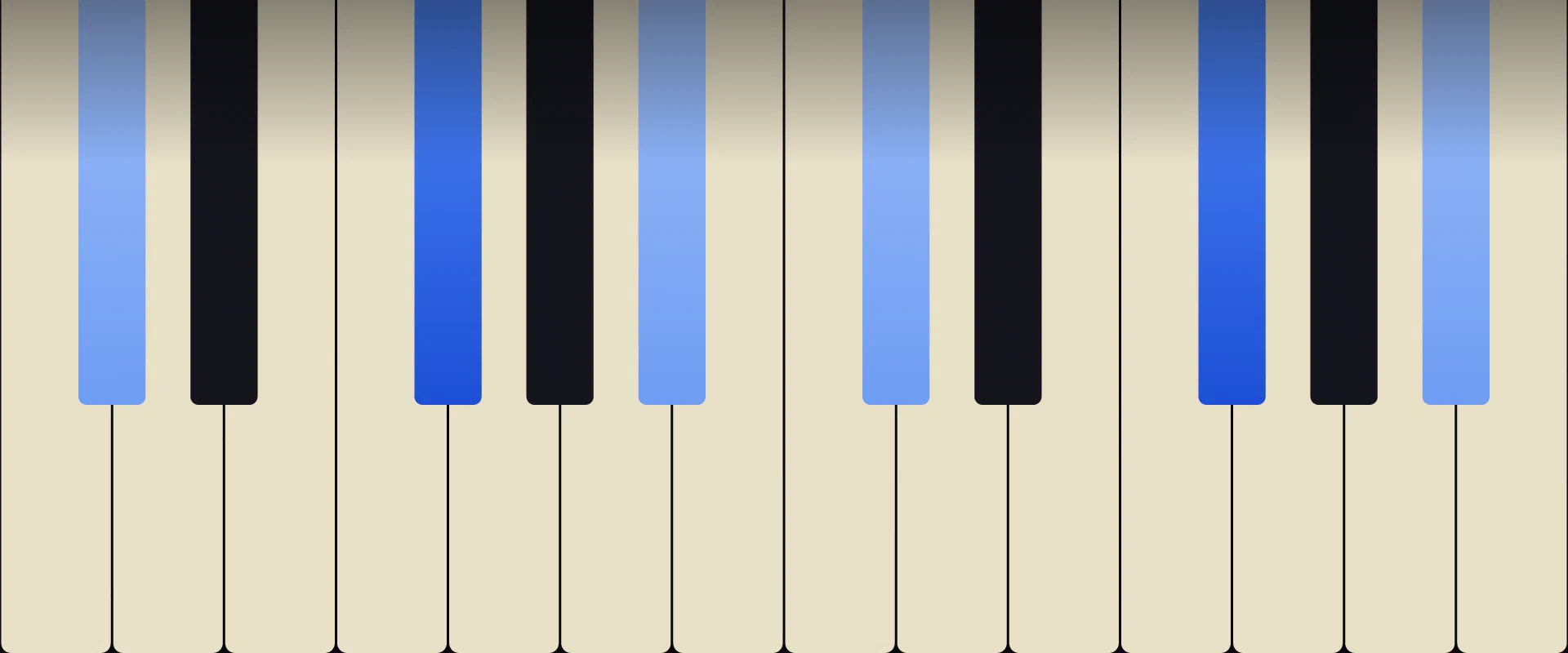
Put your right hand on F♯ major and it never touches a white key. F♯, A♯ and C♯ are all black, the only major triad of the twelve where that is true, and the fingers land on raised keys that stop them drifting. Then look at the same chord on paper, sitting in a key signature of six sharps, and it becomes one of the more intimidating things a sight reader meets. This is the chord that is easier to play than it is to read.
It is also the chord with two names. F♯ major and G♭ major are the same three notes, the same three keys under the hand, the same sound. Which one a score prints is a decision about what happens on the next page, not about anything you can hear.
Try It: F♯ in the Chord Finder
Select F♯ as the root above and the keyboard lights three black keys. Play it, then switch the root to G♭ and watch the same keys light up under different labels.
The Notes of F♯
F♯ major contains three notes.
F♯, A♯, C♯
| Degree | Note | Interval from root | Semitones |
|---|---|---|---|
| 1 | F♯ | Root | 0 |
| 3 | A♯ | Major 3rd | 4 |
| 5 | C♯ | Perfect 5th | 7 |
Every accidental is a sharp sitting on a black key, so nothing has to be talked around. There is no E♯ pretending to be F, no C♭ pretending to be B. Spelled the other way as G♭, B♭ and D♭ it is just as tidy, and neither version needs a double accidental.
That symmetry is why the two names have never resolved into one. Elsewhere on the circle of fifths one spelling is obviously cheaper: B major needs five sharps, its twin C♭ major needs seven, so nobody writes C♭. F♯ major needs six sharps and G♭ major needs six flats. This is the only point on the circle where the two cost exactly the same, so both survive.
How F♯ Is Built
A major 3rd then a minor 3rd: F♯ up to A♯ is four semitones, A♯ up to C♯ is three, and the outer perfect 5th holds the frame.
The useful comparison for this root is the chord a semitone below. F major is F, A and C, three white keys, the plainest triad on the instrument. Raise all three by one semitone and you get F♯ major, three black keys, the least plain. The whitest and blackest major triads on the keyboard are neighbours.
Drop A♯ to A natural and you have F♯ minor, far the more common of the two in guitar based music. Remove A♯ entirely and you have the F♯5 power chord that drop tuned riffing lives on.
F♯ on the Piano
Three black keys, no white ones. The right hand takes 1 on F♯, 3 on A♯ and 5 on C♯, which puts the thumb on a black key. Scale playing teaches you to avoid that, but in a triad it is fine, and it keeps the wrist high and the hand forward over the raised keys. The left hand mirrors it with 5, 3 and 1.
Black keys are narrower, so a half missed note slides into the gap, but they are raised and set back, which gives the hand somewhere natural to sit. Chopin built his teaching on that trade, starting pupils on B major and F♯ major rather than C major, on the grounds that the long middle fingers belong on the black keys and the short thumb and little finger on the white ones. C major looks simple on paper and forces the hand flat. F♯ major looks forbidding and shapes the hand correctly on the first attempt.
The cost lands in reading. Six sharps means tracking F♯, C♯, G♯, D♯, A♯ and E♯, and the last one is the trap, because E♯ is played on the white key F. The chord itself hides no such trick. The key it lives in does.
F♯ on the Guitar
There is no open F♯ major. Not one of the six open strings, E, A, D, G, B and E, belongs to this chord, so nothing can be left ringing and every string has to be fretted or muted. That sends you straight to a barre.
The standard answer is the E shape moved up two frets: barre across the 2nd fret, root on the 6th string, giving 2 4 4 3 2 2 low to high. Most guitarists meet it immediately after failing at F, and it comes as a relief. F sits at the 1st fret, where the string between nut and finger is shortest and stiffest and the nut holds it highest off the board. One fret up, the barre has more give and less height to fight. Same shape, same theoretical pressure, and almost every player finds F♯ the easier of the two.
The A shape at the 9th fret is the alternative, x 9 11 11 11 9, root on the 5th string. The frets are close together there and the action is low, and it keeps the chord clear of the bass player.
Guitarists reach this chord far more often than six sharps would suggest, because E and B are guitar keys and F♯ is the second degree of one and the fifth of the other. A player who has never read a note in F♯ major has played it thousands of times.
Inversions
| Inversion | Notes | Bass note |
|---|---|---|
| Root position | F♯ A♯ C♯ | F♯ |
| 1st inversion | A♯ C♯ F♯ | A♯ |
| 2nd inversion | C♯ F♯ A♯ | C♯ |
First inversion is where the spelling argument turns practical. In sharps the bass note is A♯, and a bass line walking A♯ to B reads slower than the identical B♭ to B natural, which is why writers expecting that motion reach for flats. See Chord Inversions and Voice Leading for how inversions smooth movement between chords.
Voicings
Keep the left hand to a shell, F♯ and C♯ a fifth apart, and let the right carry A♯, C♯ and F♯ above it. Doubling the root at the octave adds weight without mud, and because every doubled note is black the hand shape simply repeats.
On guitar, x x 4 6 7 6 is a bright close voicing on the top four strings, and 2 4 4 3 x x cuts the E shape to root, fifth, root and third for loud playing.
Which Keys Contain F♯
| Degree | Key |
|---|---|
| I | F♯ major |
| IV | D♭ major |
| V | B major |
| III | E♭ natural minor |
| VI | B♭ natural minor |
| VII | G♯ natural minor |
The list arrives spelled both ways. As a tonic and as the dominant of B it is F♯. In D♭ and B♭ minor it is G♭, because a lone sharp inside a flat key reads as a foreign body.
Where F♯ Shows Up
E, F♯, B in E major. Here it acts as a secondary dominant, V of V, which is why a major chord turns up on a degree whose diatonic version is minor. The A natural of E major lifts to A♯ and pushes hard at B. Rock and blues in E lean on this constantly, and all three chords sit within the first two frets.
G♯m, F♯, E in G♯ minor. The i, VII, VI descent, with F♯ as the flat seventh. G♯ minor is the relative minor of B major, so this loop shares its territory with the one above and runs through rock and metal in standard tuning.
B♭m, G♭, D♭, A♭. The same chord under its other name, as the VI of B♭ minor. B♭ minor is a comfortable singing key, which is how a chord of six accidentals ends up in chart pop and R&B without anyone noticing.
Instrument families pull in opposite directions. String players lean towards the sharp spelling, since a tuning in fifths favours sharp keys, and an arranger writing for horns nearly always chooses G♭. A tune published both ways is usually that, not a disagreement about the harmony. To move it somewhere friendlier, see How to Transpose a Song to Any Key.
Related Chords
- Seventh Chords: The Complete Guide for F♯7 and F♯maj7
- Extended Chords and Jazz Harmony for F♯9 and F♯13
- Suspended Chords: sus2, sus4 and Tension for F♯sus4, a common approach into this chord
- Guitar Chord Shapes: The CAGED System for the other shapes that produce F♯
Learn More
- The Circle of Fifths Explained, where the F♯ and G♭ overlap becomes visible
- Diatonic Chords: A Beginner’s Guide, for why F♯ is major in some keys and not others
- The F♯ Major Scale, the parent key, six sharps and all
Practice Chords
Drill chord recognition with a metronome, MIDI support, and score tracking.
Start Practicing