More beginner guitarists quit on F than on any other chord. It is the first chord in most method books with no open form, it asks for a full barre at the 1st fret where the strings fight back hardest, and it arrives around lesson four.
Nothing about the chord itself is difficult. F, A and C are three white keys, and a child can find them. F is hard for a reason that has nothing to do with F. Method books start in C major because C major is the easiest key to read, F is its IV chord, and so the instrument’s worst early obstacle is scheduled by a decision about notation rather than about hands.
Try It: F in the Chord Finder
Select F as the root, then switch between the keyboard and the fretboard to see the same three notes in both places and hear them played back.
The Notes of F
| Degree | Note | Interval from Root | Semitones |
|---|---|---|---|
| 1 (Root) | F | Perfect unison | 0 |
| 3 | A | Major 3rd | 4 |
| 5 | C | Perfect 5th | 7 |
F up to A is four semitones, A up to C is three. No accidental appears anywhere, and F is the only natural root sitting directly left of a group of three black keys, which makes the shape quick to find by touch.
How F Is Built
Take the F5 power chord, F and C, and drop A into the gap. The A does all the work: it is what says major rather than minor.
Swap it for A♭ and you have F minor, which flips which instrument struggles. F minor drags the pianist’s hand forward onto a black key, yet on guitar it is the easier of the two, because the barre already covers the 3rd string at the 1st fret and the middle finger comes off the neck entirely.
F on the Piano
Three white keys, no accidentals, no crossing under. Right hand plays 1, 3 and 5 on F, A and C. Left hand plays 5, 3 and 1.
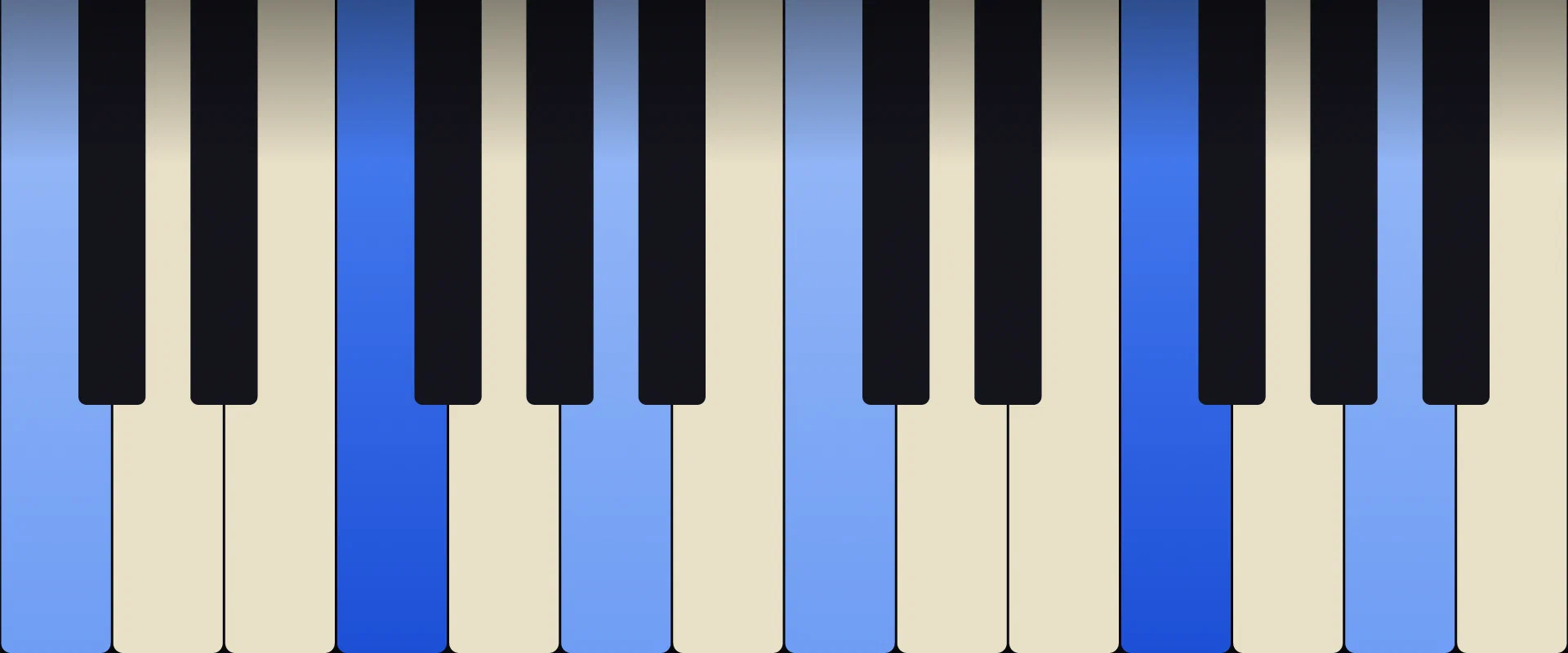
You can locate the whole chord from the black key groups without counting. F is the white key immediately left of a group of three blacks. A is the white key wedged between the second and third of that same group. C is the white key just left of the next pair of blacks.
Nothing pulls one finger deeper into the keyboard than its neighbours, so the shape sits level and the wrist can stay low. Play F minor straight afterwards and the contrast is obvious: the middle finger climbs onto A♭ and the hand tilts to follow it.
F is also the left hand’s reference note in print. The bass clef is an F clef, its two dots straddling the line F sits on, and readers have located everything else from there since before the staff settled into five lines.
F on the Guitar
The full chord is the E shape barred at the 1st fret: index flat across all six strings, middle finger on the 3rd string at fret 2, ring finger on the 5th string at fret 3, little finger on the 4th string at fret 3.
It is the hardest place on the neck to do that. Right by the nut the string is already clamped a fret away, so there is almost no slack to take up, and the force a barre needs peaks here and falls off as you move up. The same shape at fret 5 rings cleanly under far less effort. Beginners are not weak, they are being asked to start at the maximum.
The honest way in is a partial form. Barre only the 1st and 2nd strings at fret 1 with the index, add the middle finger on the 3rd string at fret 2, and strum the top three. That is A, C and F, a complete F chord in first inversion, from two fingers. Add the ring finger on the 4th string at fret 3 and the root goes underneath, giving a four string F that holds up in a full band mix.
Avoid the usual shortcut of leaving the top string open at x x 3 2 1 0. That is Fmaj7, not F. The open E sits a semitone under the root and rubs badly whenever the tune’s melody lands on F.
If the 1st fret is still not happening, the A shape barred at the 8th fret is also F, and the tension there is far kinder. Plenty of players learn F up the neck first and come back down to the nut months later. A capo also solves it: capo 1 with E shapes, capo 3 with D shapes or capo 5 with C shapes all produce F from open forms.
Inversions
| Inversion | Notes | Bass Note | Symbol |
|---|---|---|---|
| Root position | F, A, C | F | F |
| 1st inversion | A, C, F | A | F/A |
| 2nd inversion | C, F, A | C | F/C |
Most beginners’ first working F is the three string shape, so their first F is a first inversion with A in the bass. That is worth knowing: it explains why it never quite sounds like the record.
F/C is the shape behind the plagal cadence in C major: hold C in the bass, move the upper notes from C, E, G out to C, F, A and back, and the bass never shifts. F/A earns its keep in F major itself, where a bass walking A, B♭, C carries I to IV to V by step instead of by leap.
Voicings
Keep low F voicings open. F2 alone in the left hand with A3, C4 and F4 above stays clear, while F2, A2 and C3 stacked together turns to mud. F and A alone are enough if you want only the colour: the 5th says nothing about quality.
| Shape | Frets, low to high | Sounding notes |
|---|---|---|
| E shape barre, fret 1 | 1 3 3 2 1 1 | F, C, F, A, C, F |
| Four string | x x 3 2 1 1 | F, A, C, F |
| Three string | x x x 2 1 1 | A, C, F |
| A shape barre, fret 8 | x 8 10 10 10 8 | F, C, F, A, F |
Which Keys Contain F
- I of F major
- IV of C major
- V of B♭ major
- III of D natural minor
- VI of A natural minor
- VII of G natural minor
The second entry is the whole story of this page: F is the IV chord of C major, and C major is where every course begins, so F cannot be postponed the way an advanced chord can.
Where F Shows Up
C, G, Am, F in C major, a I, V, vi, IV loop, is the most recorded four chord pattern in pop music, and F is the one bar in it that beginner guitarists dread. C, F, G, C is the I, IV, V, I of the first page of every method book, and F to C on its own is the amen at the end of a hymn. Shift to the relative minor and Am, F, C, G gives i, VI, III, VII, another loop that leans on F without ever calling it home.
In F major itself, Gm7, C7, Fmaj7 is a plain ii, V, I, and in a B♭ blues F7 is the chord that turns the last four bars around.
That last pair points at who actually chooses this key. B♭ trumpets and tenor saxophones read concert F as their own G, the French horn is pitched in F outright, and concert band writing sits in F and B♭ for exactly that reason. Guitarists never choose it: the open strings spell E, A, D, G and B, so guitar bands drift to those keys instead.
So F is a border. A song sketched at a piano or written for horns lands in F, and the moment a guitar led band picks it up someone suggests E or G. It travels the other way too, and guitar tunes arranged for a horn section get pulled into F.
Related Chords
- Diatonic Chords: A Beginner’s Guide places F as the IV chord inside a key.
- Seventh Chords: The Complete Guide covers Fmaj7 and F7.
- Chord Inversions and Voice Leading goes further into F/A and F/C.
- Guitar Chord Shapes: The CAGED System explains why the E shape and the A shape both land on F.
Learn More
F sits one step anticlockwise from C on the circle of fifths, the first flat key in that direction. For extensions such as F9 and F13, see Extended Chords and Jazz Harmony, and for every scale containing this chord, see Scales for Piano and Guitar: The Complete Reference Guide.
Practice Chords
Drill chord recognition with a metronome, MIDI support, and score tracking.
Start Practicing