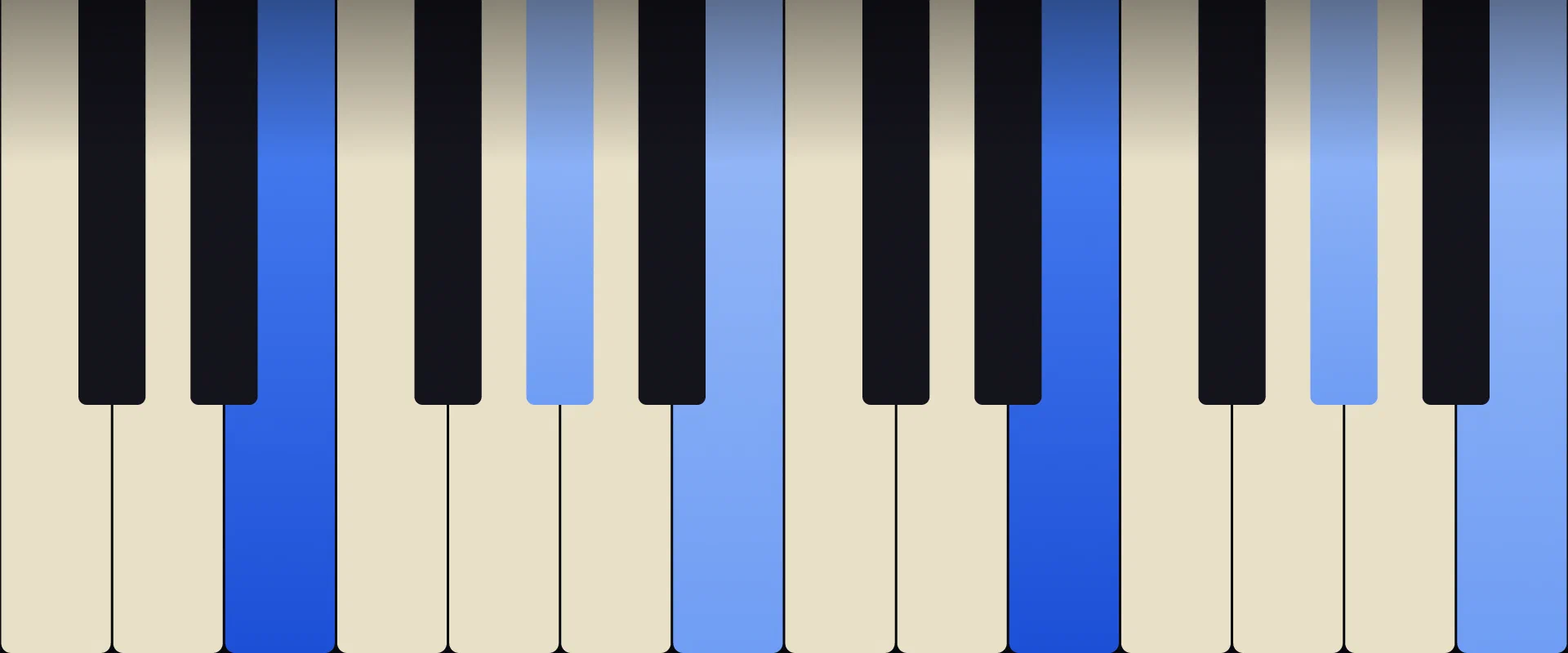
Strike an open E on a guitar and you are hearing the loudest chord the instrument can make. Its root is the lowest open string, three of the six strings ring untouched, and nothing else on the neck combines that much bass with that much sustain. Almost everything about this chord’s reputation follows from that one piece of hardware. Rock, blues and metal default to it, lowered tunings are described by how far they sit below it, and the fingering became the template that every barre chord borrows. On a piano the same three notes, E, G♯ and B, are pleasant and entirely ordinary.
Try It: E in the Chord Finder
Select E as the root to hear the triad, see the notes light up on the keyboard, and step through the chords that sit alongside it.
The Notes of E
E major takes the 1st, 3rd and 5th degrees of the E major scale:
E, G♯ and B
| Degree | Note | Interval from Root |
|---|---|---|
| 1 (Root) | E | Perfect unison |
| 3 | G♯ | Major 3rd |
| 5 | B | Perfect 5th |
G♯ is the only accidental, and it lands on a black key between G and A. No enharmonic trap to explain away.
How E Is Built
Stack a major 3rd from E up to G♯ (four semitones), then a minor 3rd from G♯ up to B (three semitones). The nearest simpler chord is E minor: flatten that G♯ to G. Guitarists almost always meet E minor first, because on the fretboard it is this chord with one finger removed rather than one added. Put a D on top and you have E7, the engine of every blues in this key. Push the third up to A and you have Esus4, which is the open form plus a single extra finger.
E on the Piano
At the keyboard, E major is a mild shape in a mildly awkward key, the exact reverse of its standing on a fretboard. Two of its three notes are white. The one black key, G♯, sits in the middle of the group of three, giving the hand a single unmistakable landmark to build around.
Right hand: thumb on E, third finger on G♯, fifth finger on B.
Left hand: fifth finger on E, third finger on G♯, thumb on B.
Both outer fingers stay on white keys, and both sit immediately to the right of a black-key cluster: E after the group of two, B after the group of three. Only the middle finger travels inwards, so the shape rolls without any shuffling of the wrist.
The key of E major is another story. Four sharps put it outside what most pianists sight read comfortably, and orchestral writing avoids it because brass and woodwind are pitched in flats. Keyboard players usually arrive here from the outside: accompanying a guitarist, or following a singer whose range lands there.
E on the Guitar
The open form is 0 2 2 1 0 0, and it repays a look at what those six strings actually sound from the bottom up: E, B, E, G♯, B, E. Three E’s, two B’s, and exactly one major third, buried in the middle of the stack. That ratio is why the chord holds together under heavy distortion when richer voicings turn to porridge. It is very nearly a power chord with one note of colour added.
Nothing is fretted above the 2nd fret, so the strings vibrate at close to full length, and the fretting hand sits nowhere near the three open strings, so nothing damps them. Volume and sustain arrive free of charge.
The usual fingering is index on the 3rd string at the 1st fret, middle and ring on the 5th and 4th at the 2nd. Many players switch to middle, ring and little finger, which frees the index to drop across the nut as a barre. That single motion turns this shape into F.
Slide the whole form up behind a barre and you have the E shape of the CAGED system, the template that produces F at the 1st fret, G at the 3rd, A at the 5th, and E itself again at the 12th. The 1st fret version is the barre most learners fight with, because tension is highest and the frets widest at the nut. Barred at the 12th the same grip is easy, so that is the sensible place to practise it before walking it back down.
Tuning conventions are anchored here too. Standard tuning is named for this note, drop D lowers the sixth string a whole tone while the rest stays put, and E♭ standard, D standard and the other metal tunings are all counted downwards from this reference point.
Inversions
| Voicing | Notes | Bass note |
|---|---|---|
| Root position | E G♯ B | E |
| 1st inversion | G♯ B E | G♯ |
| 2nd inversion | B E G♯ | B |
On a piano an inversion is one small movement of the hand. On a guitar in first position it is a fight, because the open sixth string keeps insisting on E underneath everything. Getting G♯ into the bass means fretting the 4th fret of the sixth string and letting only the top strings ring: 4 x x 1 0 0 gives E/G♯. For B in the bass, x 2 x 1 0 0 uses the 5th string at the 2nd fret. Both trade weight for mobility, which is the point of them.
Voicings
- Open form, 0 2 2 1 0 0, the full six strings and maximum weight.
- Top three strings, x x x 1 0 0, sounding G♯ B E. A quiet first inversion that sits neatly above a bass player.
- E5, 0 2 2 x x x, the third dropped entirely for riff work.
- Barre, E shape at the 12th fret, the same chord an octave higher and far easier to voice-lead from.
- Piano spread, low E in the left hand with E, G♯ and B close together in the right.
Keep the G♯ above middle C when the left hand plays a low E. A major third stacked close to the bass sounds thick on any instrument. The guitar’s open form sidesteps this by accident, putting its only third on the 4th string up from the bottom.
Which Keys Contain E
E major is diatonic to six common keys, three major and three minor:
- I of E major
- IV of B major
- V of A major
- III of C♯ natural minor
- VI of G♯ natural minor
- VII of F♯ natural minor
The two that matter most on a guitar are the first and the third. This is the tonic of its own key and the V of A major, and A is the only other root the instrument hands you as an open bass string. Two adjacent open strings a fifth apart is a small piece of luthiery with outsized consequences for which keys guitar music gets written in.
Where E Shows Up
Blues in E. The twelve bar in E is the default jam key. E7 is the open form with one finger lifted, 0 2 0 1 0 0, A7 has its own open shape, and B7, x 2 1 2 0 2, is one of the few open-position seventh chords available at all. A harmonica player picks up an A harp, plays second position and lands in E without thinking about it.
I ♭VII IV rock. E, D, A. All three sit in first position with their roots on open or near-open bass strings, which is why these three changes carry so much of the classic rock riff vocabulary. Move the progression up one semitone and every chord needs a barre.
The Andalusian cadence. Am, G, F, E. Flamenco, and everything that has borrowed from flamenco, comes to rest on E major where the ear half expects a minor chord. On nylon strings the final chord lets the low string ring on under the melody, which is precisely what the idiom wants.
I V vi IV pop. E, B, C♯m, A. This one exposes the limits of the guitar’s generosity: C♯m wants a barre at the 4th fret and B is either a barre or the open B7, which changes the colour. Singers who need this progression in E are often handed a capo instead. The key that is kindest to riffs is not automatically kind to pop changes.
Step away from stringed instruments and E major thins out fast. Orchestral repertoire leans to flat keys because the horns and reeds are built in them, and choirs are rarely asked to read four sharps without good reason. This chord’s prominence is a fact about how a guitar is strung, not about harmony.
Related Chords
- Seventh Chords: A Complete Guide to maj7, min7, dom7, and More covers E7, Emaj7 and Em7.
- Suspended Chords: Sus2, Sus4, and the Art of Tension for Esus2 and Esus4.
- Extended Chords: Which Tensions Work, and How to Voice Them for E9 and E13.
- Guitar Chord Shapes and the CAGED System for moving the E shape up the neck.
Learn More
- Diatonic Chords: A Beginner’s Guide to Building Chords from Scales explains why E major appears where it does in each of the six keys above.
- Chord Inversions and Voice Leading goes further into choosing a bass note.
- The Circle of Fifths Explained places E major’s four sharps in context.
- E Major Scale: Notes, Chords, and How to Play It is the scale this chord is drawn from.
Practice Chords
Drill chord recognition with a metronome, MIDI support, and score tracking.
Start Practicing