Ask an alto saxophonist to play a written C and you will hear E♭. Ask a trumpeter for a written F and you get the same pitch. That accident of instrument design is why E♭, G and B♭ is not just another triad but the resting place of an entire half of the orchestra. Alto and baritone saxophones are pitched in E♭, trumpets and tenor saxophones in B♭, so concert E♭ is the note where everybody’s parts come out looking tidy. Three flats in the key signature look forbidding on paper, and yet this chord turns up in march trios, big band shout choruses and Beethoven symphonies more than almost any other.
Try It: E♭ in the Chord Finder
The Notes of E♭
The chord contains three notes: E♭, G and B♭.
| Degree | Note | Interval from root | Semitones |
|---|---|---|---|
| 1 | E♭ | Root | 0 |
| 3 | G | Major 3rd | 4 |
| 5 | B♭ | Perfect 5th | 7 |
Written as a chord symbol it is simply E♭. No quality suffix is needed, because a bare letter name always means a major triad.
How E♭ Is Built
Start on E♭, count four semitones up to G, then three more to B♭. A major third underneath a minor third, in that order, is what makes the chord major rather than minor.
The simpler chord underneath it is the E♭ power chord, E♭ and B♭ with nothing in between. Add the G and the chord commits to a mood. Flatten that G to G♭ instead and you get E♭ minor, at which point all three notes become black keys and the key signature jumps to six flats. That is an unusually wide gap between a major triad and the parallel minor sitting right beside it.
E♭ on the Piano
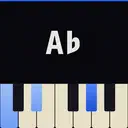
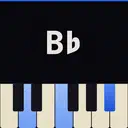
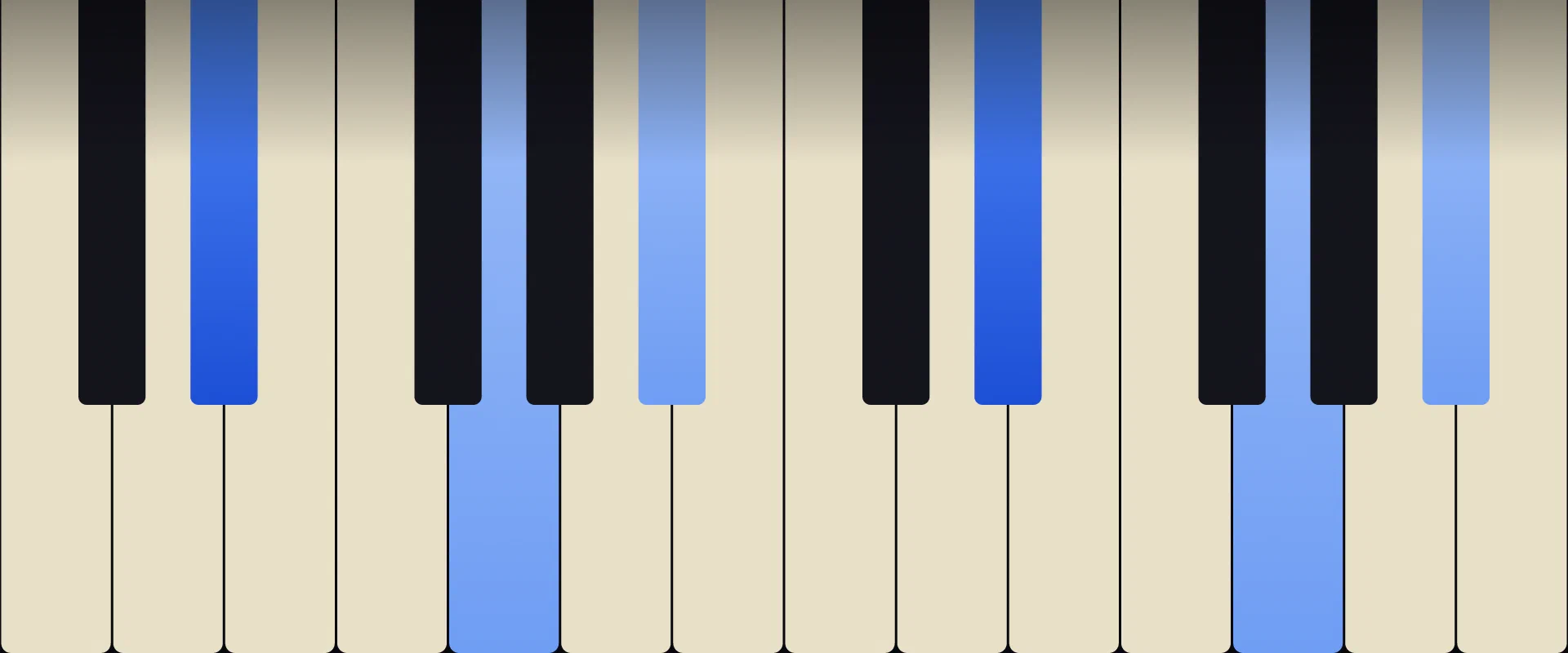
Two of the three notes are black. E♭ is the upper black key of the group of two, B♭ is the upper black key of the group of three, and G is the single white key sitting between the raised pair. Nothing about the spelling is a trap here: every accidental in the chord lands on a black key, so what you read is what you press.
Right hand fingering is 1 on E♭, 3 on G, 5 on B♭. Left hand mirrors it, 5 on E♭, 3 on G, 1 on B♭. Beginners tend to assume that a chord with two flats in it must be harder than an all white shape, and it is usually the reverse. Because E♭ and B♭ are raised by the same amount, the thumb and the little finger land at the same height and the wrist stays level. Shapes with a single black note tilt the hand, and the tilt is what makes them feel unstable.
The middle finger has the only real job. G is narrow at the back, hemmed in by F♯ on one side and G♯ on the other, so play it in that slot rather than pulling the whole hand forward. Once the hand learns to sit back among the black keys, the chord almost holds itself.
One warning about habits. The E♭ major scale is fingered 3 1 2 3 4 1 2 in the right hand precisely so the thumb never lands on E♭ or B♭. The triad breaks that rule happily, because a chord is struck rather than passed through. Do not let the scale talk you out of the thumb on the root.
E♭ on the Guitar
There is no open E♭ shape. Not an awkward one, not a stretchy one, none at all, and the nearest open chords sit a semitone away on either side. Every E♭ a guitarist plays is therefore a barre, a partial shape or a capo trick.
The standard grip is the A shape barred at the 6th fret, x 6 8 8 8 6, with the root on the 5th string. This is one of the friendlier barres on the neck. It falls in the comfortable middle rather than down at the nut, where the fretting hand has to fight the stiffest part of the string and the widest fret spacing. The E shape at the 11th fret, 11 13 13 12 11 11, gives a deeper root but pushes the hand into the region where the frets crowd together and the neck joins the body.
For a compact voicing high in the texture, take the D shape up one fret: x x 1 3 4 3. Three notes on the top strings, one finger short of a barre, and it cuts through a horn arrangement without muddying the low end.
Guitarists who work in horn bands mostly stop fighting and reach for a capo. Put it at the 3rd fret and the whole E♭, A♭, B♭ set becomes C, F and G shapes. Put it at the 1st fret and the same progression becomes D, G and A. Both tricks turn a chart written for saxophones into open position guitar, which is why capos appear on soul and gospel stages far more often than rock ones.
One last snag: fretboard diagrams and tuner apps label the 6th fret of the A string D♯. It is the same pitch, but a guitarist hunting for E♭ can stare straight past it.
Inversions
| Inversion | Notes | Lowest note |
|---|---|---|
| Root position | E♭ G B♭ | E♭ |
| 1st inversion | G B♭ E♭ | G |
| 2nd inversion | B♭ E♭ G | B♭ |
First inversion is the pianist’s friend, because it puts the thumb on white G and leaves only one black key for the outer finger. Second inversion, B♭ E♭ G, is the most compact of the three and the one to use when moving to A♭ or B♭, since B♭ is already the common tone.
Voicings
Spread the chord for weight: root E♭ in the left hand, then B♭ and G above it in the right, so the third sits on top and the interval between the outer voices opens to a tenth. Close it back up for comping.
In four part wind or brass writing, double the root rather than the third. G is the note that gives E♭ its brightness, and two of them in a close chord will overbalance the whole texture. On guitar, the three note version x 6 8 8 x x sits better under a vocal than the full six string barre, which doubles both the root and the fifth.
Which Keys Contain E♭
- I of E♭ major
- IV of B♭ major
- V of A♭ major
- III of C natural minor
- VI of G natural minor
- VII of F natural minor
Where E♭ Shows Up
I, IV, V in E♭ major: E♭, A♭, B♭. The three chord backbone of march trios, brass band repertoire and traditional gospel. British brass bands are built almost entirely from B♭ and E♭ instruments, right down to the E♭ soprano cornet at the top and the E♭ bass at the bottom, so this progression is close to a mother tongue for that ensemble.
ii7, V7, Imaj7: Fm7, B♭7, E♭maj7. The jazz cadence, in the key where horn players prefer to meet. Concert B♭, E♭ and F are the default blues and standards keys for exactly the transposition reasons above, and a rhythm section that cannot play fluently in three flats will not last long behind a horn section.
Fm, E♭, D♭, C. Here E♭ is the VII chord of F minor, the second step of a descending line towards the dominant. The chord functions as passing colour rather than home, and it sounds completely different from the same triad functioning as I.
Gm, E♭, B♭, F. E♭ as the VI of G minor, the loop behind an enormous amount of film scoring and minor key pop. The E♭ is the moment the progression opens out and stops sounding bleak.
Then there is the classical inheritance. Natural horns were crooked in E♭, meaning the player fitted a length of tubing that put the instrument’s whole harmonic series in this key. Composers who wanted horns to sound heroic wrote in E♭ because the horns could actually play there, and the habit outlived the hardware. Beethoven’s Eroica symphony, his Emperor concerto, Mozart’s 39th and Strauss’s first horn concerto are all in E♭, and they all sound the way they do partly because of a piece of brass tubing.
Related Chords
- Suspended Chords: Sus2 and Sus4
- Guitar Chord Shapes: The CAGED System
- Chord Progressions Every Musician Should Know
- Secondary Dominants and Borrowed Chords
Learn More
Practice Chords
Drill chord recognition with a metronome, MIDI support, and score tracking.
Start Practicing