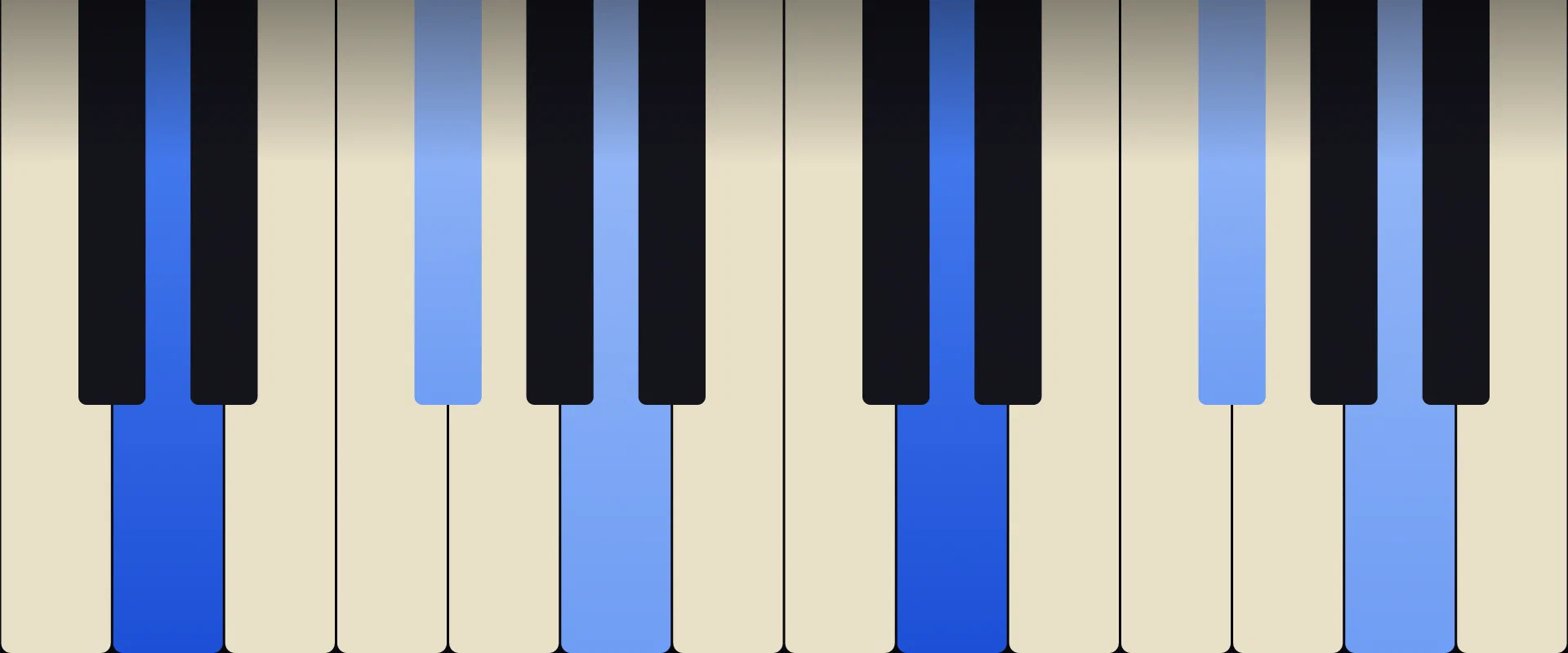
Tune a violin, a viola or a cello and two of the four strings you have just set are notes of D major. The violin runs G, D, A, E; the viola and cello both run C, G, D, A. On every one of them the D and the A sit open, unfingered, free. A guitar gives you the same two notes on its 4th and 5th strings. No other triad is handed that much of itself by the instruments before a finger goes down.
The resonance runs deeper than the two notes you can see. The open D string’s harmonic series produces A as its third partial and F♯ as its fifth, so both notes you have to finger are already latent in the string. Play D major anywhere on a violin and the open D vibrates in sympathy whether you bow it or not. Fiddle tunes, bluegrass and Baroque orchestral writing sit in this key for that reason.
Try It: D in the Chord Finder
The Notes of D
D major is a three-note chord: D, F♯ and A.
| Degree | Note | Interval from Root | Semitones |
|---|---|---|---|
| 1 (Root) | D | Perfect unison | 0 |
| 3 | F♯ | Major 3rd | 4 |
| 5 | A | Perfect 5th | 7 |
Written as a chord symbol it is simply D, no suffix. The F♯ is the only accidental and it is what keeps D major out of the key of C: anything in C major that wants a D chord gets D minor.
How D Is Built
Start from the bare fifth D and A, the interval both violin and guitar hand you for nothing. That shell is stable but says nothing about mood. Drop F♯ into the middle, four semitones above the root, and the chord commits to major. Lower it a semitone to F natural and you have D minor, which shares two notes and none of the character.
Stacked in thirds it reads D to F♯ (major) then F♯ to A (minor). That order is what makes the triad major.
D on the Piano
Only one of the three notes is a black key, and it falls exactly where the hand wants it. The right hand takes D with the thumb, F♯ with the middle finger and A with the little finger. The middle finger is the longest you own and F♯ sits furthest back, so the hand arches without being asked. A triad of three white keys forces the hand flat and forward; this one does not.
The left hand mirrors it: little finger on D, middle on F♯, thumb on A. Beginners often meet this chord right after C major, because the single black key teaches the arched hand shape without demanding a stretch.
First inversion is the awkward one. Putting F♯ in the bass lands the right thumb on a black key, pushing the hand in towards the fallboard and shortening the little finger’s reach to the D above. Practise it slowly, wrist level.
D on the Guitar
The open shape is x x 0 2 3 2, and the two crosses at the start are the whole story. You only get four strings. The lowest note is the open 4th string D, which means this chord starts a fourth higher than open G or open E and has no bass under it at all. Strummed alone it sounds bright and thin. Next to an open G it can sound like the guitar has stepped back a pace.
Those four strings give you D, A, D, F♯ from low to high. The third sits on top, which almost no other common open chord does: open E, A, G and C all put a root or a fifth on the highest string. That exposed F♯ is why an open D cuts through a mix and sounds sweet rather than solid.
Fingering is compact: index on the 3rd string at the 2nd fret, middle on the 1st at the 2nd, ring on the 2nd at the 3rd. The shape sits near the nut where strings are stiffest, but no finger has to press a wound string, so it is far kinder than an F barre.
For weight, add the open 5th string (x 0 0 2 3 2) to put A in the bass, or tune the 6th string down to D and play 0 0 0 2 3 2. Barring the A shape at the 5th fret, x 5 7 7 7 5, lands where the neck has loosened up and the barre is genuinely comfortable, unlike the same grip at the 1st fret. The E shape at the 10th fret, 10 12 12 11 10 10, gives six strings of D.
Two alternative tunings exist mainly to serve this chord. Open D tuning (D, A, D, F♯, A, D) tunes the guitar to a D major chord outright, which is why blues and folk slide players reach for it. DADGAD swaps that F♯ for a G, giving Dsus4, and waits for you to resolve it.
Inversions
| Inversion | Bass Note | Notes | Symbol |
|---|---|---|---|
| Root position | D | D, F♯, A | D |
| 1st inversion | F♯ | F♯, A, D | D/F♯ |
| 2nd inversion | A | A, D, F♯ | D/A |
D/F♯ is unusually easy on guitar, and unusually common because of it. F♯ sits on the 6th string at the 2nd fret, where a hooked thumb naturally rests, so the shape becomes 2 0 0 2 3 2. That cheap inversion is behind a great many descending bass lines in acoustic songwriting.
D/A is cheaper still: let the open 5th string ring.
Voicings
Guitar, open (x x 0 2 3 2). D, A, D, F♯. The bright default, third on top.
Guitar, thumbed bass (2 0 0 2 3 2). Adds F♯ below for D/F♯.
Guitar, drop D (0 0 0 2 3 2). Root doubled two octaves down, and the reason drop D exists.
Guitar, A shape barred at fret 5 (x 5 7 7 7 5). Movable, controlled, easy to mute for funk.
Piano, close (D, F♯, A in one hand). Compact and clear, ideal under a melody.
Piano, spread (left hand D and A, right hand F♯ and D). The fifth opens out into the bass and the third stays high, which is what a string section does with this chord.
Which Keys Contain D
D major appears as a diatonic chord in six common keys:
- I of D major
- IV of A major
- V of G major
- III of B natural minor
- VI of F♯ natural minor
- VII of E natural minor
Where D Shows Up
I, IV, V in D: D, G, A. The default key of old-time and bluegrass fiddling, for arithmetic reasons rather than taste. On a violin tuned G, D, A, E, the D chord has open D and A, G major has open G and D, and A major has open A and E. All three lean on two open strings each. No other key gives you that, which is why a session that calls a tune in D needs no discussion.
I, V, vi, IV in D: D, A, Bm, G. The pop workhorse. Every one of the four chords has a comfortable open or near-open guitar shape, so capos rarely come out for songs written here.
i, VI, VII in E minor: Em, C, D. D arrives as the flat seventh rather than a dominant, which means it pushes back to Em without ever resolving like a leading-note chord. Rock and folk lean on this loop constantly, and on guitar it is three open shapes in a row.
V of G: the turnaround G, Em, C, D. Here D is under tension and wants to fall back to G. Its F♯ is the leading note of the key, which is the same F♯ that felt like home a moment ago in D major. The note has not moved. Its job has.
The Baroque orchestra had its own reason to live here. Natural trumpets and timpani were built in D, so festive writing went there by default, and the string section’s open D and A amplified the tonic for free. Pachelbel’s Canon is practically a study in that resonance. The violin concertos of Beethoven, Brahms and Tchaikovsky are all in D major too, and none of that is coincidence.
Related Chords
- Suspended Chords: Sus2, Sus4 and Tension covers Dsus4, the chord DADGAD tuning hands you.
- Seventh Chords: The Complete Guide for D7 and Dmaj7.
- Extended Chords and Jazz Harmony for D9 and D13.
- The D Major Scale, where this chord is the tonic.
- The B Natural Minor Scale, the relative minor.
Learn More
Practice Chords
Drill chord recognition with a metronome, MIDI support, and score tracking.
Start Practicing