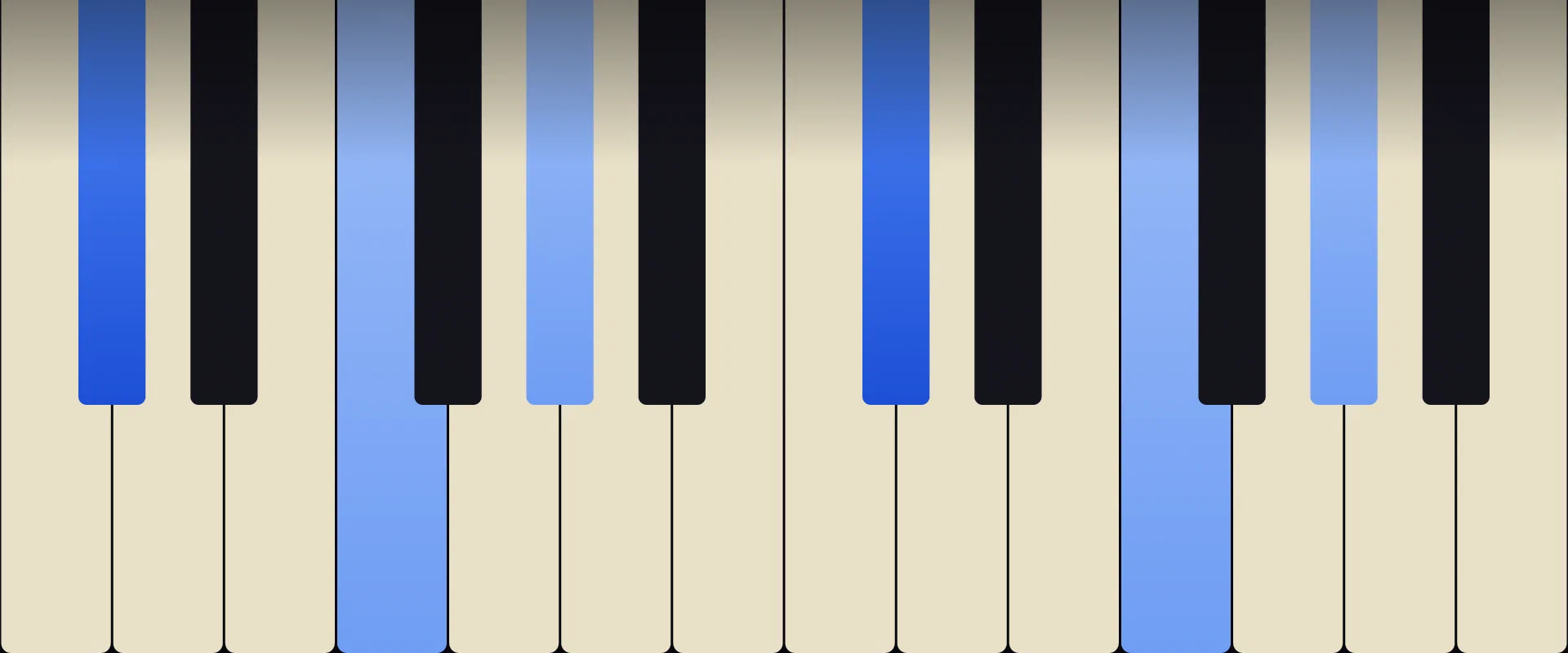
Spelled out in full, C♯ major looks like a misprint: C♯, E♯, G♯. Go looking for E♯ on a keyboard and you will not find a black key between E and F♯, because there isn’t one. E♯ is played on the white key F. Almost every reader meeting this chord for the first time assumes the page has a typo, and almost every reader is wrong. That one accidental is the most interesting thing about C♯ major, and it is the reason published music usually prints the chord as D♭ instead.
Try It: C♯ in the Chord Finder
The Notes of C♯
| Degree | Note | Interval from root | Semitones |
|---|---|---|---|
| 1 | C♯ | Root | 0 |
| 3 | E♯ | Major 3rd | 4 |
| 5 | G♯ | Perfect 5th | 7 |
Count four semitones up from C♯ and you land on F: D, then D♯, then E, then F. The pitch is F. The name is E♯. Those two statements do not contradict each other, and the next section explains why.
How C♯ Is Built
A triad is a stack of thirds, and a third is counted in letters before it is counted in semitones. From C you count C, D, E, so the third of any chord rooted on some kind of C must be some kind of E. Sharpen the root to C♯ and the third has to move with it: E becomes E♯. Writing the note as F would make the interval C♯ to F, which spans four letters and reads as a diminished fourth, not a major third.
The payoff is visual. On a staff, a root position triad is three note heads on three consecutive lines, or three consecutive spaces, a small snowman that any reader recognises instantly as a chord. C♯, E♯, G♯ draws that snowman. C♯, F, G♯ does not: the F sits a step out of line and the shape stops looking like a triad at all.
The same logic scaled up to a whole key is why you rarely see this chord written as C♯. The C♯ major scale needs seven sharps, E♯ and B♯ among them. Its twin D♭ major needs five flats and no oddities. Same pitches, two fewer accidentals, and no note that lands on a key the reader associates with a different letter. Editors pick D♭ almost every time.
Strip the chord back and you get C♯5, just C♯ and G♯, the bare power chord. Add E♯ in the middle and it becomes major. Lower that E♯ by a semitone to E natural and you get C♯ minor, which needs no accidental for its third at all. That asymmetry matters in practice: C♯ minor is one of the best-loved keys in the piano repertoire, while C♯ major as a key signature is a curiosity.
C♯ on the Piano
Two of the three notes are black keys, C♯ and G♯, and they sit either side of a single white key, F. That layout is friendlier than it sounds. F has a narrow rear section that runs back between E and F♯, right at the level of the black keys, so the middle finger can take it without the hand dropping forward. All three fingers stay in one plane and the wrist stays level.
Right hand, root position: 1 on C♯, 3 on E♯, 5 on G♯. Left hand, the mirror: 5, 3, 1. Keep the thumb and little finger far enough back on the black keys that they are not perched on the rounded front edge, and let the middle finger meet F between the two black keys rather than out at the front.
The reading problem is worse than the playing problem. In a score written in F♯ minor, the key signature carries three sharps and E♯ is not one of them, so every C♯ major chord arrives with a sharp sign printed in front of a note sitting on the E line. Sight readers stumble there far more often than their fingers do. The fix is to stop translating and start associating: that note head with that accidental means F, every time.
C♯ on the Guitar
There is no open C♯ major. Open shapes lean on open strings, all six are tuned to naturals, and none of the five open major forms reaches this root without fretting everything. The chord is a barre chord or it is nothing.
The usual choice is the A shape barred at the 4th fret, with the root on the 5th string. It is the harder of the two options for most players: an index barre plus a second flattened finger across the D, G and B strings at the 6th fret, and it sits low enough on the neck that string tension is still stiff. The E shape at the 9th fret is easier to hold, gives a full six string voicing and a solid low root, but sits high and sounds noticeably thinner.
Capos change the calculation completely. Clamp the 1st fret and an open C shape sounds C♯. Clamp the 4th fret and an open A shape sounds C♯. Both tricks turn an awkward barre into a first position chord, which is a large part of why so much recorded guitar music sits in this key without anyone involved ever counting to seven sharps.
One shape, two names. When the surrounding key uses flats, the chart will call this chord D♭ and your fingers will not notice the difference.
Inversions
| Inversion | Notes | Lowest note |
|---|---|---|
| Root position | C♯ E♯ G♯ | C♯ |
| 1st inversion | E♯ G♯ C♯ | E♯ |
| 2nd inversion | G♯ C♯ E♯ | G♯ |
First inversion puts the awkward note in the bass. A bass player reading E♯ plays F, and a chart writer who wants that sound in a flat context will write D♭/F rather than C♯/E♯. Second inversion, with G♯ underneath, is the standard cadential shape when this chord functions as a dominant.
Voicings
Split it across two hands. Left hand takes the bare fifth C♯ and G♯, right hand takes E♯, G♯ and C♯ above it. Dropping the fifth from the right hand leaves C♯ and E♯ a tenth apart, which is the cleanest way to voice this chord low without it sounding muddy.
Adding a seventh gives you two very different chords. C♯7, with B natural on top, is the dominant that resolves to F♯. C♯maj7, with B♯ on top, is the one that will make a reader do a double take twice in the same chord: B♯ is played on the white key C. If that is a bar too far, the chart almost certainly wants D♭maj7 instead.
Which Keys Contain C♯
- I of D♭ major
- IV of A♭ major
- V of F♯ major
- III of B♭ natural minor
- VI of F natural minor
- VII of E♭ natural minor
The first entry is worth a second look. The key in which this chord is the tonic points at D♭ major, not C♯ major, and that is deliberate: both spellings sound identical, and the flat one is the one that gets printed. Four of the six keys listed are flat keys, where this chord is called D♭ throughout. C♯ is its minority spelling.
Where C♯ Shows Up
The chord earns its sharp spelling almost entirely in one job: dominant of F♯ minor. That key sits beautifully on guitar, and the two chords are neighbours on the neck, F♯m as an E shape barred at the 2nd fret and C♯ as an A shape two frets along.
| Progression | Chords | Turns up in |
|---|---|---|
| i VII VI V in F♯ minor | F♯m, E, D, C♯ | Andalusian cadence, flamenco, surf, metal |
| i iv V in F♯ minor | F♯m, Bm, C♯ | Minor key pop and rock |
| I IV V in F♯ major | F♯, B, C♯ | Guitar rock played with a capo |
| i iv V I in C♯ minor | C♯m, F♯m, G♯, C♯ | Baroque and classical endings |
That last row is the other classic sighting. A piece in C♯ minor closing on a C♯ major chord is a tierce de Picardie, the old habit of ending a minor movement on a major tonic, and it requires E♯ every single time.
Away from guitar, the chord tends to be renamed before it is played. Brass and wind players read flat keys far more fluently, so an arranger scoring for horns writes D♭ and thinks no more about it. Singers arrive here by accident, since dropping a song a semitone from D and lifting one a semitone from C both land on this root.
Related Chords
- Suspended Chords: Sus2, Sus4 and Tension covers C♯sus4, which replaces E♯ with F♯ and sidesteps the spelling issue entirely
- Seventh Chords: The Complete Guide for C♯7 and C♯maj7
- Chord Inversions and Voice Leading for choosing between root position and the two inversions above
- Guitar Chord Shapes: The CAGED System for moving the A and E shapes to any root
Learn More
- Diatonic Chords: A Beginner’s Guide
- The Circle of Fifths Explained, where C♯ and D♭ meet at the bottom of the circle
- D♭ Major Scale, the key this chord calls home
- Extended Chords and Jazz Harmony
Practice Chords
Drill chord recognition with a metronome, MIDI support, and score tracking.
Start Practicing