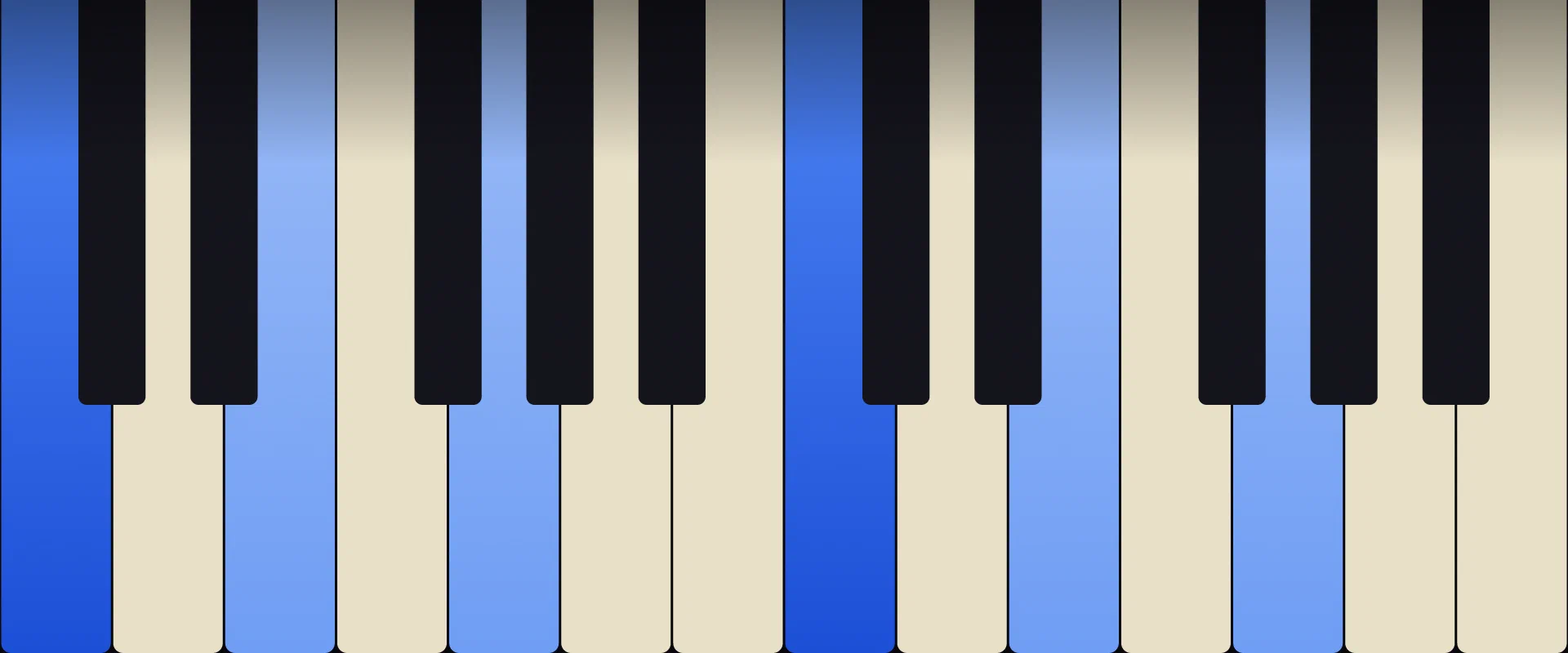
Nothing in C major needs an accidental. C, E and G are three white keys, and that one fact has shaped how the chord is taught for two centuries. It is the first chord in almost every method book, the shape a beginner’s hand gets placed on before any theory is explained, and the chord every other major triad ends up being measured against: shift all three notes up two semitones and you have D major, lower the middle note by one and you have C minor. Being the reference point is genuinely useful. It is also why C major is the most over-represented chord in print, and the one working musicians most often transpose away from the moment a singer opens their mouth.
Try It: C in the Chord Finder
Set the root to C and watch all three notes light up on the keyboard with nothing on the black keys.
The Notes of C
| Degree | Note | Interval from root | Semitones |
|---|---|---|---|
| 1 (root) | C | Perfect unison | 0 |
| 3 | E | Major 3rd | 4 |
| 5 | G | Perfect 5th | 7 |
Written out: C, E, G. No sharps, no flats, and no enharmonic argument to have about any of them.
How C Is Built
Start from the bare fifth C and G, the interval a guitarist calls a C5 power chord. It is stable but tells you nothing about mood. Drop E into the middle, four semitones above C, and the chord commits to major. Move that E down to E♭ and you have C minor; raise it to F and you have Csus4, which is why the sus chord feels like it is leaning on something. Stack a B on top for Cmaj7 or a B♭ for C7, and the chord stops being a resting place and starts pointing somewhere.
C on the Piano
The whole chord sits on the flat plane of the keyboard: thumb on C, third finger on E, fifth finger on G in the right hand, and 5, 3, 1 going up in the left. No finger has to reach forward between the black keys, so the hand stays in one shallow position and the wrist stays level. That is the easiest hand shape a pianist will ever be asked to make.
The catch is that all white means no landmarks. Chords containing a black key give the fingers something raised to find without looking, and C major gives them nothing. Beginners who learn to locate C by counting from the left edge of the keyboard tend to lose the chord as soon as they look away. The reliable landmark is the group of two black keys: C is the white key immediately to their left, every octave, all the way up. Find that group by touch and the chord assembles itself.
Because the shape is so flat, it also rewards a habit that pays off later. Keep the fingers curved rather than lying flat, even though nothing forces you to. The identical grip transferred up to D or E major suddenly has black keys in it, and a hand that has been playing C major with collapsed knuckles will stumble on the first chord that demands any lift.
C on the Guitar
The open form is x 3 2 0 1 0, and it is a harder first chord than its reputation suggests. The stretch runs from the 3rd fret of the 5th string down to the 1st fret of the 2nd string, a diagonal across three frets and four strings that small hands genuinely struggle with. Compare it with the E or A shapes, which sit in a single fret column, and the reason C major is where a lot of beginners stall becomes obvious.
The 6th string is the other complication. Left open it sounds a low E, which turns the chord into first inversion with the third in the bass. That is a perfectly good sound, but it is not what the chart asked for, so the string is normally damped by the underside of the third finger. Fret it at the 3rd fret instead and you get G in the bass: 3 3 2 0 1 0, second inversion, and a fuller, rounder chord that many players prefer for strumming.
Only two open strings actually ring in the chord, the 3rd string G and the 1st string E, so C major is thinner and higher in the bass than the open-string powerhouses of G, D, E and A. That is a large part of why guitar-driven pop drifts out of C: the instrument simply sounds better a few steps either side of it.
For a movable version, C is the CAGED C shape, and the barre form is the A shape barred at the 3rd fret. That barre is comfortable, well clear of the stiff first fret, and it is the position most players reach for when they need C major to sit in the same register as a barred F or G.
Inversions
| Inversion | Notes | Bass | Symbol |
|---|---|---|---|
| Root position | C E G | C | C |
| 1st inversion | E G C | E | C/E |
| 2nd inversion | G C E | G | C/G |
C/E is the workhorse of the three. It sits inside descending bass lines such as C, C/E, F, G, where the bass walks down while the harmony barely moves. C/G is the pedal option: hold G underneath and C major and G major trade places without the bass shifting at all, a device hymn writers and film composers both lean on. For the voice leading behind all of this, see Chord Inversions and Voice Leading.
Voicings
Three notes stacked in the right hand is the textbook version and the thinnest one. Split the chord instead: low C alone in the left hand, then E, G and C in the right, and the gap between them gives the chord air. Doubling the root at the top rather than the fifth keeps it sounding grounded.
On guitar the open position is unusually generous with variations, because the 3rd and 2nd strings are free to move:
| Shape | Frets | Result |
|---|---|---|
| C | x 3 2 0 1 0 | Plain triad |
| Cmaj7 | x 3 2 0 0 0 | Open, floating |
| C7 | x 3 2 3 1 0 | Pulls towards F |
| Cadd9 | x 3 2 0 3 0 | Bright, ringing |
| Csus4 | x 3 3 0 1 1 | Suspended, unresolved |
| C/G | 3 3 2 0 1 0 | Fuller, G in bass |
Which Keys Contain C
- I of C major
- IV of G major
- V of F major
- III of A natural minor
- VI of E natural minor
- VII of D natural minor
Where C Shows Up
| Progression | Chords | Context |
|---|---|---|
| I V vi IV (C major) | C, G, Am, F | The default pop loop |
| ii V I (C major) | Dm7, G7, Cmaj7 | Jazz standards, teaching |
| I IV V (G major) | G, C, D | C as the subdominant |
| I IV V (F major) | F, B♭, C | C as the dominant |
The first two are the reason C turns up so often in teaching material: an author writing about the I V vi IV loop or the ii V I will pick C to write it in, because the example stays free of key signature clutter. That habit is self-reinforcing. Generations of readers meet every progression in C first and then have to do the transposing work themselves.
Instruments push the same way. Children’s glockenspiels, tin whistles and simple recorder repertoire default to C, and so do most first-year piano books. Against that, C is awkward for singers: it lands low for a lot of tenors and uncomfortably in the passaggio for altos, so choral directors move pieces out of it routinely. Brass and reed players have a different complaint. A B♭ trumpet reading concert C major has to play D major, and an alto saxophone has to play A major, so the key everyone else calls simple is the one that gives them sharps to think about.
Guitarists solve it with a capo. Play the friendly open G shapes and clamp at the 5th fret and the result is C major, which is exactly how a great deal of recorded acoustic music that is nominally in C was actually fingered.
Related Chords
- Suspended Chords: sus2 and sus4 for Csus2 and Csus4
- Seventh Chords: The Complete Guide for Cmaj7 and C7
- Extended Chords and Jazz Harmony for C9, C11 and C13
- Guitar Chord Shapes: The CAGED System for moving the C shape up the neck
Learn More
Practice Chords
Drill chord recognition with a metronome, MIDI support, and score tracking.
Start Practicing