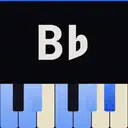
F Mixolydian Scale: Notes, Chords, and How to Play It
F Mixolydian is the sound of New Orleans funk and horn sections. Built on the 5th degree of B♭ major, it shares those same notes but treats F as home. F7 is one of the most common chords in jazz and blues, and brass players in particular gravitate towards F Mixolydian because B♭ instruments read it comfortably. The two flats (B♭ and E♭) keep it manageable on any instrument.
What Makes Mixolydian Different from Major?
The Mixolydian mode is almost identical to the major scale. The only difference is the flatted seventh degree — the note one whole step below the root instead of a half step. In F Mixolydian, this means E♭ instead of E.
This ♭7 removes the leading tone — that half-step pull from the 7th degree up to the root that gives the major scale its strong sense of resolution. Without it, Mixolydian sounds more open, relaxed, and bluesy. The tonic chord is naturally a dominant 7th (F7) rather than a major 7th, which is exactly why Mixolydian is the go-to scale for playing over dominant 7th chords in jazz and blues.
For a broader overview of how modes work, see Modes Explained: Dorian to Locrian.
Notes of the F Mixolydian Scale
The F Mixolydian scale contains seven notes:
F – G – A – B♭ – C – D – E♭
These are the same notes as B♭ major, but starting and resolving on F. The scale follows the Mixolydian interval pattern — W – W – H – W – W – H – W.
| Degree | Note | Interval from Root | Step to Next |
|---|---|---|---|
| 1 (Root) | F | Unison | Whole step |
| 2 | G | Major 2nd | Whole step |
| 3 | A | Major 3rd | Half step |
| 4 | B♭ | Perfect 4th | Whole step |
| 5 | C | Perfect 5th | Whole step |
| 6 | D | Major 6th | Half step |
| 7 | E♭ | Minor 7th | Whole step |
| 8 | F | Octave | — |
The half steps fall between A–B♭ (degrees 3–4) and D–E♭ (degrees 6–7). Compare this to F major, where the half steps fall between A–B♭ and E–F. The only change is that final interval: E♭ replaces E.
Parent Major Scale
F Mixolydian is the 5th mode of B♭ major. This means it uses exactly the same notes as B♭ major but with F as the tonal centre.
| Scale | Notes |
|---|---|
| B♭ major | B♭ – C – D – E♭ – F – G – A |
| F Mixolydian | F – G – A – B♭ – C – D – E♭ |
To find the parent major scale for any Mixolydian mode, go down a perfect 5th (or up a perfect 4th) from the root.
Comparison with F Major
Since Mixolydian differs from major by just one note, a direct comparison is the clearest way to understand the mode:
| Scale | Notes | 7th Degree |
|---|---|---|
| F major | F – G – A – B♭ – C – D – E | Major 7th |
| F Mixolydian | F – G – A – B♭ – C – D – E♭ | Minor 7th |
That single change — E to E♭ — transforms the sound. The major scale pulls strongly towards resolution; the Mixolydian mode sits comfortably without that tension.
F Mixolydian on Piano
F Mixolydian has two flats: B♭ and E♭. This is the same key signature as B♭ major. The scale starts on F and sits comfortably under the hands, with two black keys providing natural landmarks.
Right hand fingering (ascending): 1 – 2 – 3 – 4 – 1 – 2 – 3 – 1 (thumb crosses under after B♭, then fingers walk up through E♭ to F)
Left hand fingering (ascending): 5 – 4 – 3 – 2 – 1 – 3 – 2 – 1 (after the thumb plays C, the third finger crosses over to D)
Hold an F7 chord with the left hand while running the scale with the right to reinforce the Mixolydian sound and train your ear to hear F as home.
F Mixolydian on Guitar
F Mixolydian works well at the 1st position on guitar, with the root on the 6th string 1st fret.
1st position (low to high):
| String | Fret | Note |
|---|---|---|
| 6th (E) | 1 | F |
| 6th (E) | 3 | G |
| 5th (A) | open | A |
| 5th (A) | 1 | B♭ |
| 5th (A) | 3 | C |
| 4th (D) | open | D |
| 4th (D) | 1 | E♭ |
| 4th (D) | 3 | F |
This covers one octave from F on the 6th string to F on the 4th string. The open A and D strings are both scale tones (the 3rd and 6th degrees), making open-position playing very convenient.
Use the guitar fretboard view in the Interactive Chord Finder to see all positions at once.
Diatonic Chords in F Mixolydian
Stacking thirds on each scale degree produces these seven triads:
| Degree | Chord | Quality | Notes |
|---|---|---|---|
| I | F | Major | F – A – C |
| ii | Gm | Minor | G – B♭ – D |
| iii° | Adim | Diminished | A – C – E♭ |
| IV | B♭ | Major | B♭ – D – F |
| v | Cm | Minor | C – E♭ – G |
| vi | Dm | Minor | D – F – A |
| ♭VII | E♭ | Major | E♭ – G – B♭ |
The ♭VII chord (E♭ major in F Mixolydian) is the characteristic chord of the mode. The movement from F to E♭ — a whole-step drop — is the quintessential Mixolydian sound.
For more on how diatonic chords are constructed, see Diatonic Chords: A Beginner’s Guide.
Seventh Chords
Adding a fourth note to each triad creates seventh chords:
| Degree | Chord | Quality | Notes |
|---|---|---|---|
| I7 | F7 | Dominant 7th | F – A – C – E♭ |
| ii7 | Gm7 | Minor 7th | G – B♭ – D – F |
| iiiø7 | Am7♭5 | Half-diminished | A – C – E♭ – G |
| IVmaj7 | B♭maj7 | Major 7th | B♭ – D – F – A |
| v7 | Cm7 | Minor 7th | C – E♭ – G – B♭ |
| vi7 | Dm7 | Minor 7th | D – F – A – C |
| ♭VIImaj7 | E♭maj7 | Major 7th | E♭ – G – B♭ – D |
The tonic chord is a dominant 7th (F7). In jazz, F7 is one of the most frequently encountered dominant chords, and F Mixolydian is the default scale choice when you see it on a chart.
For more on seventh chords, see Seventh Chords: The Complete Guide.
Common Chord Progressions in F Mixolydian
Mixolydian progressions tend to be simpler and more riff-driven than major key progressions.
| Progression | Chords | Style |
|---|---|---|
| I – ♭VII | F – E♭ | Mixolydian vamp, rock riffs |
| I – ♭VII – IV | F – E♭ – B♭ | Classic rock, folk-rock |
| I – IV – ♭VII – IV | F – B♭ – E♭ – B♭ | Southern rock, country |
| I – IV | F – B♭ | Blues-rock vamp |
| I – v – ♭VII – IV | F – Cm – E♭ – B♭ | Pop-rock, indie |
| I7 – IV7 | F7 – B♭7 | Blues, funk |
The I – ♭VII movement (F – E♭) features heavily in New Orleans funk and second-line music.
For a deeper dive into how progressions work, see Chord Progressions Every Musician Should Know.
Songs That Use F Mixolydian
F Mixolydian is a favourite in funk, jazz, and New Orleans music:
- “Cissy Strut” — The Meters (F7 funk groove)
- “Chameleon” — Herbie Hancock (sections)
- “Pick Up the Pieces” — Average White Band (sections)
- “Freddie Freeloader” — Miles Davis (F7 blues head)
- “The Chicken” — Jaco Pastorius
- “Watermelon Man” — Herbie Hancock
Listen for the ♭7 note (E♭) in the melody or the ♭VII chord (E♭ major) in the harmony — these are the tell-tale signs of Mixolydian rather than plain major.
Related Scales and Modes
F Mixolydian belongs to the B♭ major family. All seven modes share the same notes:
| Scale / Mode | Starting Note | Character |
|---|---|---|
| B♭ major (Ionian) | B♭ | Bright, resolved |
| C Dorian | C | Minor with a lifted feel |
| D Phrygian | D | Dark, Spanish flavour |
| E♭ Lydian | E♭ | Dreamy, floating major |
| F Mixolydian | F | Bluesy, relaxed major (you are here) |
| G natural minor (Aeolian) | G | Dark, reflective |
| A Locrian | A | Unstable, diminished |
Practice Tips
Emphasise the ♭7. Play F major ascending, then play F Mixolydian. The only difference is E vs E♭ — train your ear to hear that subtle but powerful shift.
Vamp on I – ♭VII. Alternate between F and E♭ chords while improvising with the scale. This locks in the Mixolydian sound.
Play over an F7 drone. Hold an F7 chord or use a backing track that sits on F7. Improvise with the scale and notice how E♭ fits perfectly over the chord.
Learn a funk rhythm. F7 is a staple of funk rhythm guitar and keyboard. Practise rhythmic comping on F7 while a friend (or backing track) plays the melody in F Mixolydian.
Try the New Orleans groove. Play an F – E♭ – B♭ – F pattern with a swung rhythm. This is the classic second- line Mixolydian feel.
Try It Yourself
Open the Interactive Chord Finder, select F as the root and Mixolydian as the scale. You will see every note highlighted on the piano keyboard or guitar fretboard, the step pattern visualised as intervals, and all diatonic chords laid out in a table — ready to play and explore.
For the complete list of scales in every key, see Scales for Piano and Guitar: The Complete Reference Guide.
Practice Chords
Drill chord recognition with a metronome, MIDI support, and score tracking.
Start PracticingRelated Articles
A Mixolydian Scale: Notes, Chords, and How to Play It
Apr 26, 2026 · 8 min
A♭ Mixolydian Scale: Notes, Chords, and How to Play It
Apr 26, 2026 · 8 min
B Mixolydian Scale: Notes, Chords, and How to Play It
Apr 26, 2026 · 8 min