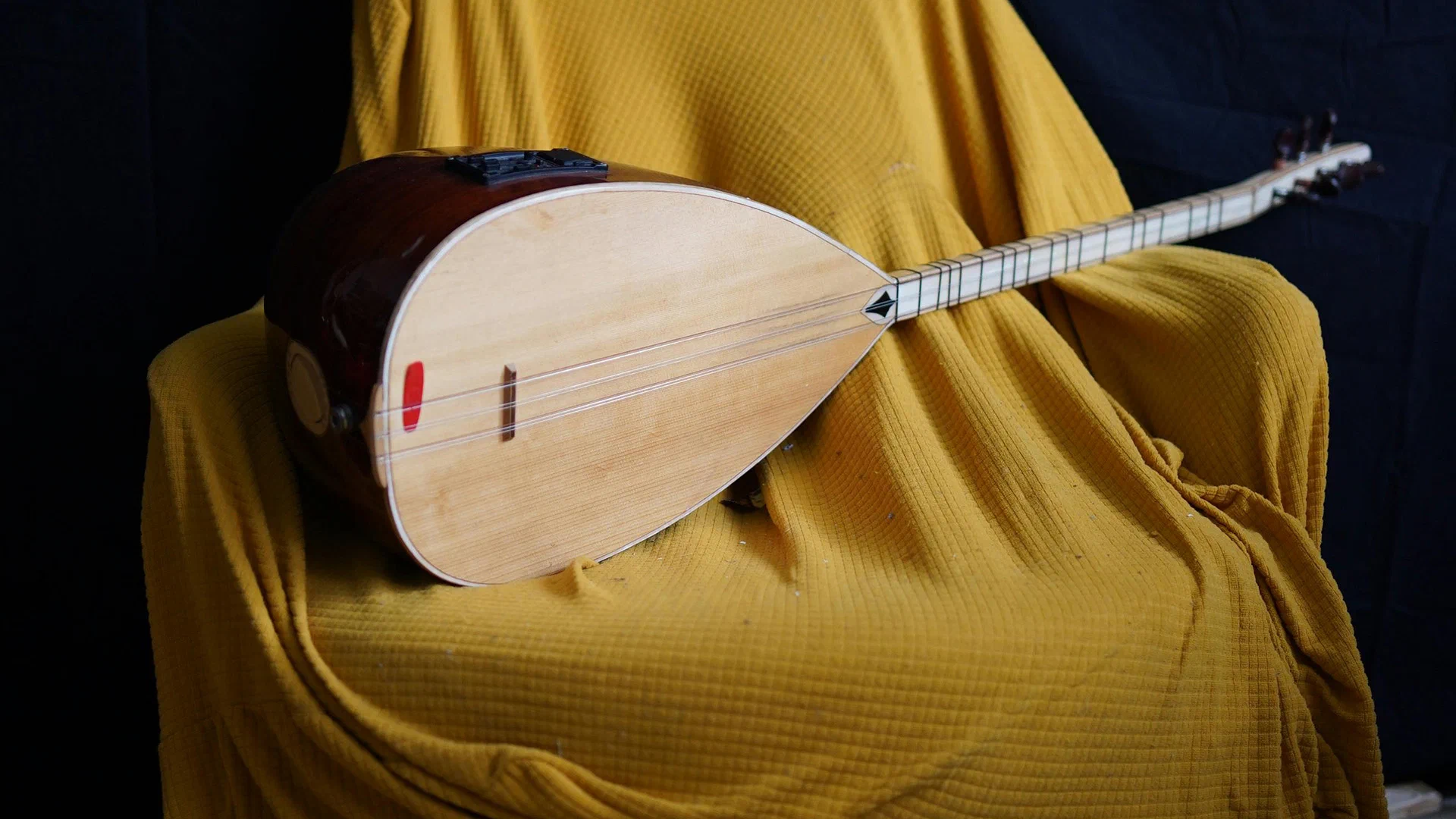
The opening riff of Dick Dale’s “Miserlou” is one of the most instantly recognisable guitar lines in popular music. It races up and down a scale that sounds nothing like major or minor — something urgent, exotic, and slightly dangerous. That scale is the double harmonic, and its distinctive sound has travelled from Middle Eastern and Eastern Mediterranean traditions into surf rock, progressive metal, film scores, and video game soundtracks.
Building the Double Harmonic Scale
The double harmonic scale — also called the Byzantine scale, Arabic scale, or double harmonic major — is a seven-note scale with a striking interval formula.
| Degree | 1 | ♭2 | 3 | 4 | 5 | ♭6 | 7 |
|---|---|---|---|---|---|---|---|
| Interval from root | Unison | Minor 2nd | Major 3rd | Perfect 4th | Perfect 5th | Minor 6th | Major 7th |
In the key of E, the notes are: E – F – G♯ – A – B – C – D♯ – E.
| Step | E→F | F→G♯ | G♯→A | A→B | B→C | C→D♯ | D♯→E |
|---|---|---|---|---|---|---|---|
| Size | Half | Aug. 2nd | Half | Whole | Half | Aug. 2nd | Half |
The name “double harmonic” comes from those two augmented seconds — the wide, expressive leaps between the ♭2 and 3, and between the ♭6 and 7. The harmonic minor scale has one augmented second (between ♭6 and 7). This scale has two, hence “double harmonic.”
Those augmented seconds are the entire personality of the scale. They create intervals that sound foreign to ears trained on standard major and minor patterns, producing the unmistakable “Middle Eastern” flavour that Western listeners associate with the region’s music.
Comparing It to Familiar Scales
Seeing the double harmonic alongside major and harmonic minor makes its distinctive features pop.
| Scale | 1 | 2 | 3 | 4 | 5 | 6 | 7 |
|---|---|---|---|---|---|---|---|
| Major (Ionian) | 1 | 2 | 3 | 4 | 5 | 6 | 7 |
| Harmonic minor | 1 | 2 | ♭3 | 4 | 5 | ♭6 | 7 |
| Double harmonic | 1 | ♭2 | 3 | 4 | 5 | ♭6 | 7 |
The double harmonic shares its major 3rd and major 7th with the regular major scale, giving it a bright, almost triumphant quality on those degrees. But the ♭2 and ♭6 pull it toward darkness and tension. That coexistence of brightness and shadow is what makes the scale so dramatic.
The Diatonic Chords
Building chords by stacking thirds from each degree of the double harmonic scale produces an unusual set of harmonies.
| Degree | Chord in E double harmonic | Quality |
|---|---|---|
| I | E | Major |
| ♭II | F | Major |
| iii | G♯dim | Diminished |
| iv | Am | Minor |
| v | B | Major (or Bsus♭2) |
| ♭VI | C | Major |
| vii | D♯dim | Diminished |
The most immediately striking feature is the ♭II major chord sitting a half step above the tonic. That I – ♭II – I movement — E to F and back to E — is the quintessential double harmonic sound. It appears in traditional Turkish and Arabic music, in film music set in the Middle East, and throughout Dick Dale’s surf rock catalogue.
Open the Interactive Chord Finder, select E as the root and Double Harmonic as the scale, and the Diatonic Chords table will show you all seven chords with their notes and qualities. Click any chord to hear it played on the piano keyboard.
Modes of the Double Harmonic Scale
Like any seven-note scale, the double harmonic has seven modes — each starting on a different degree. Several of them have established names and musical applications.
| Mode | Starting degree | Common name | Character |
|---|---|---|---|
| 1st | 1 | Double harmonic major | Dramatic, Middle Eastern |
| 2nd | ♭2 | Lydian ♯2 ♯6 | Bright and exotic |
| 3rd | 3 | Ultraphrygian | Very dark, extreme tension |
| 4th | 4 | Hungarian minor | Romani, klezmer sound |
| 5th | 5 | Oriental | Ambiguous, floating |
| 6th | ♭6 | Ionian ♯2 ♯5 | Augmented, shimmering |
| 7th | 7 | Locrian 𝄫3 𝄫7 | Extremely unstable |
The Hungarian minor (4th mode) is the most widely used of these in Western music. It appears in klezmer, Romani music, Liszt’s Hungarian Rhapsodies, and many metal compositions. The Interactive Chord Finder lists Hungarian Minor as a separate scale — try selecting it to explore its diatonic chords independently.
The Double Harmonic in Popular Music
Surf rock and Dick Dale
Dick Dale brought the scale to mainstream Western ears in 1962 with his version of “Miserlou,” a traditional Eastern Mediterranean folk melody. Played at blistering speed on a Fender Stratocaster through a cranked reverb-drenched amp, the double harmonic scale became inseparable from the surf rock sound. The song’s revival in the opening scene of Pulp Fiction introduced it to another generation.
Metal and progressive rock
Metal guitarists are drawn to the double harmonic for its angular, aggressive character. The augmented seconds lend themselves to fast alternate-picked runs that sound more dramatic than standard minor scale passages. Bands like Rainbow, Yngwie Malmsteen, and Marty Friedman have all made extensive use of the scale and its modes.
Film and television
Whenever a film needs to signal “the Middle East” in its score, the double harmonic scale is usually the first tool composers reach for. It appears in scores for Lawrence of Arabia, various Bond films, and countless television shows. While this usage can veer into stereotype, the scale itself has deep musical legitimacy in the traditions it originates from.
Classical crossover
Composers from Eastern Mediterranean and Middle Eastern traditions have always used this scale as a primary melodic resource. In the Western classical tradition, it appears in works by Debussy, Bartók, and Rimsky-Korsakov, often in passages intended to evoke an Eastern atmosphere.
Playing the Double Harmonic Scale
The augmented seconds create a physical challenge on most instruments. On guitar, the three-fret stretches required for the augmented-second intervals demand careful left-hand positioning. On piano, the irregular pattern of whole steps, half steps, and augmented seconds means the fingering does not follow the comfortable patterns of major or minor scales.
Here is a practical fingering for E double harmonic on piano (right hand):
E (1) – F (2) – G♯ (3) – A (1) – B (2) – C (3) – D♯ (4) – E (5)
The thumb tuck after G♯ keeps the hand in a comfortable position for the upper half of the scale.
For guitarists, try this pattern on a single string first to hear the intervals clearly before distributing the notes across multiple strings. Starting on the open low E string: 0 – 1 – 4 – 5 – 7 – 8 – 11 – 12. The clusters at frets 0–1, 4–5, 7–8, and 11–12 with the wide gaps between them are the visual signature of the double harmonic on the fretboard.
Composing with the Double Harmonic Scale
The ♭II chord is your most powerful compositional tool in this scale. A simple vamp between I and ♭II — E and F major in the key of E — immediately establishes the double harmonic sound. From there, you can build outward:
Progression 1 (cinematic): I – ♭II – I – iv → E – F – E – Am
Progression 2 (driving rock): I – ♭VI – ♭II – I → E – C – F – E
Progression 3 (dark and tense): i – ♭II – vii°– I → Em – F – D♯dim – E
Experiment with alternating between the major I chord and passages that use the ♭2 and ♭6 as melody notes over it. The clash between the major third in the chord and the minor second in the melody is not an error — it is the tension that gives this scale its emotional power.
Where to Go from Here
The double harmonic scale is a gateway to the world of exotic and non-Western scales available in the Interactive Chord Finder. If you enjoy its sound, explore the Hungarian minor (its 4th mode), the Persian scale, or the Arabic scale — each has its own set of diatonic chords and musical traditions. For context on how the double harmonic relates to more familiar Western scales, revisiting the major scale and harmonic minor articles will sharpen your ear for the specific intervals that make each scale unique.
Select Double Harmonic in the Interactive Chord Finder, pick a root key, and let your ear guide you. The scale has been captivating listeners across cultures for centuries — once you start playing it, you will understand why.
Practice Chords
Drill chord recognition with a metronome, MIDI support, and score tracking.
Start Practicing